How to Improve Customer Engagement: 15 Strategies for 2027




The short answer: respond faster, use two-way channels (especially SMS), and make follow-up automatic instead of optional. According to the Salesmsg 2026 State of SMS Benchmark Report, outbound SMS gets a 45% reply rate vs. under 5% for email, businesses pairing SMS with calling see 2.6x higher engagement, and 42% of replies come from follow-up messages, not the first text. The 15 strategies below are built on this data.
TL;DR: Customer engagement for B2B teams comes down to three things: speed (respond in minutes, not hours), channel (SMS gets 9x the response rate of email), and persistence (42% of replies come from follow-ups). Pair texting with calling from the same number for a 2.6x engagement lift. Keep messages under 100 characters. Use AI agents for the first response, humans for the real conversation. The full breakdown and all the data are below.
Most customer engagement advice is written for enterprise B2C brands with million-dollar martech stacks. It assumes you have a CDP, an omnichannel orchestration platform, and a team of 50 campaign managers.
If you run a B2B sales or marketing team of 5 to 50 people, that advice doesn't apply to you. Your engagement problem is simpler and harder at the same time: you need real conversations with leads and customers, and you need them to happen fast enough that people actually respond.
Every strategy in this guide can be implemented with a CRM (HubSpot or Salesforce), a business texting platform, and the team you already have. No enterprise martech required.
What is customer engagement (and why B2B teams should care)?
Customer engagement is the two-way interaction between your business and your customers across every touchpoint. It's not impressions, opens, or clicks. It's whether people actually respond, reply, book meetings, ask questions, and come back.
For B2B teams, engagement looks different than B2C. You're not optimizing cart abandonment emails or loyalty point redemptions. You're trying to get a prospect to text you back after a demo, a customer to respond to a renewal check-in, or a new lead to answer your call within the first five minutes.
The stakes are real. Research from Bain & Company shows that increasing customer retention by just 5% can raise profits by 25% to 95%. And the Salesmsg benchmark data shows that 57% of teams send their first text within 30 minutes of a new lead arriving, but only 14% have fully automated that first touch to go out in under a minute. That gap between "fast" and "instant" is where deals are won or lost.
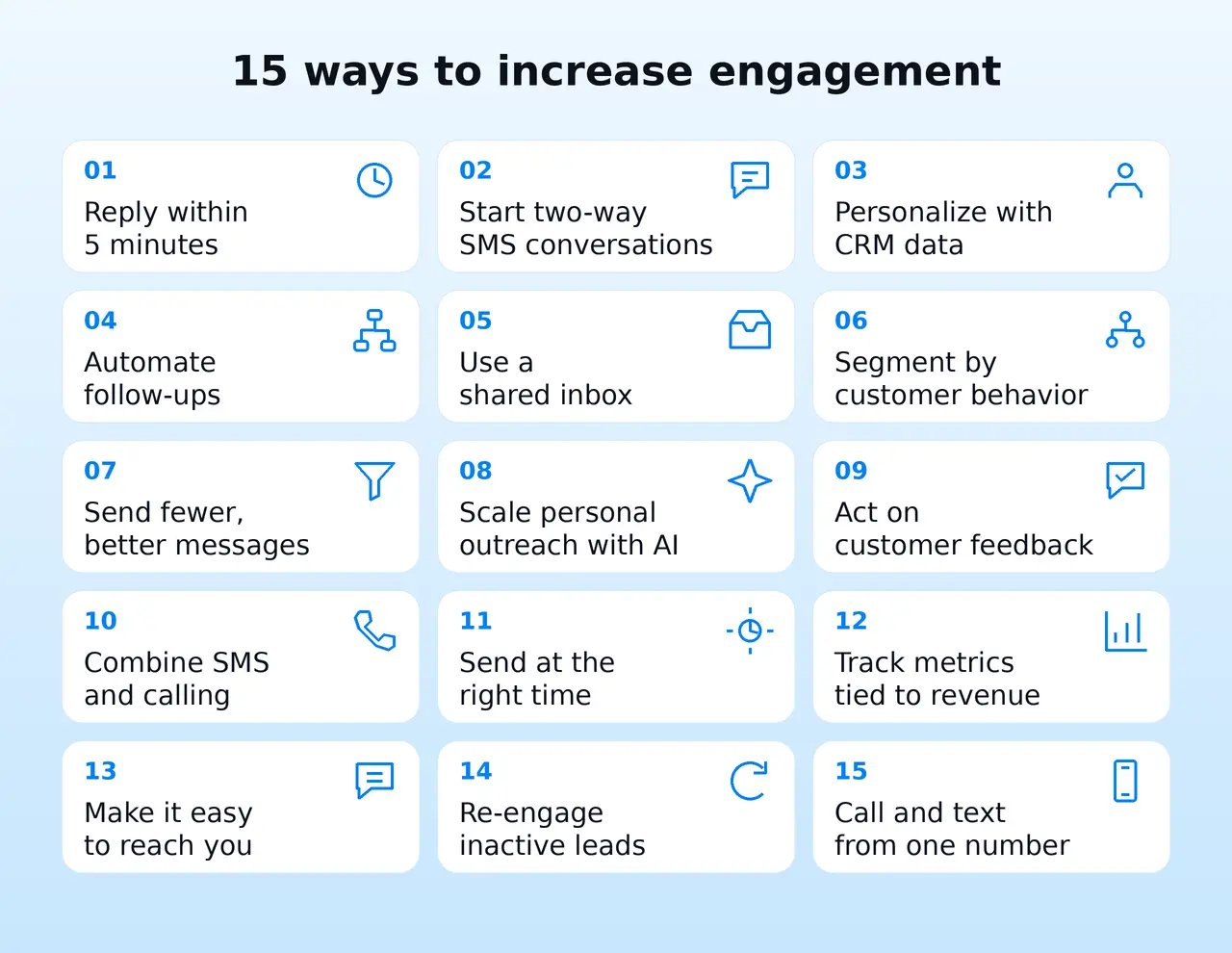
15 proven strategies to increase customer engagement
1. Respond to leads within 5 minutes
Speed is the single biggest factor in whether a lead becomes a conversation. Most companies take hours to follow up on form fills and demo requests. By then, the prospect has moved on or called a competitor.
The Salesmsg benchmark report found that only 14% of businesses have fully automated their first text to go out in under one minute. Another 29% respond within five minutes. Everyone else is slower, and slower means fewer conversations.
Set up CRM-triggered notifications that alert your team the moment a lead comes in. Better yet, use an automated first-touch SMS that fires instantly: "Hey [Name], got your request. Want to set up a quick call today?" That buys your team time while confirming the lead is real.
For more on why response time matters, see our breakdown of speed to lead.
2. Use two-way SMS for conversations, not blasts
SMS has a 98% open rate, with 90% of messages read within three minutes (Salesmsg 2026 Benchmark Report). But most companies use texting like a megaphone: one-way broadcasts with no way for the customer to reply.
Two-way SMS changes the dynamic. When a customer can text back "Yes, 2pm works" or "Can you send me the pricing doc?", you're having a conversation, not running a campaign. That conversation builds trust faster than any nurture sequence.
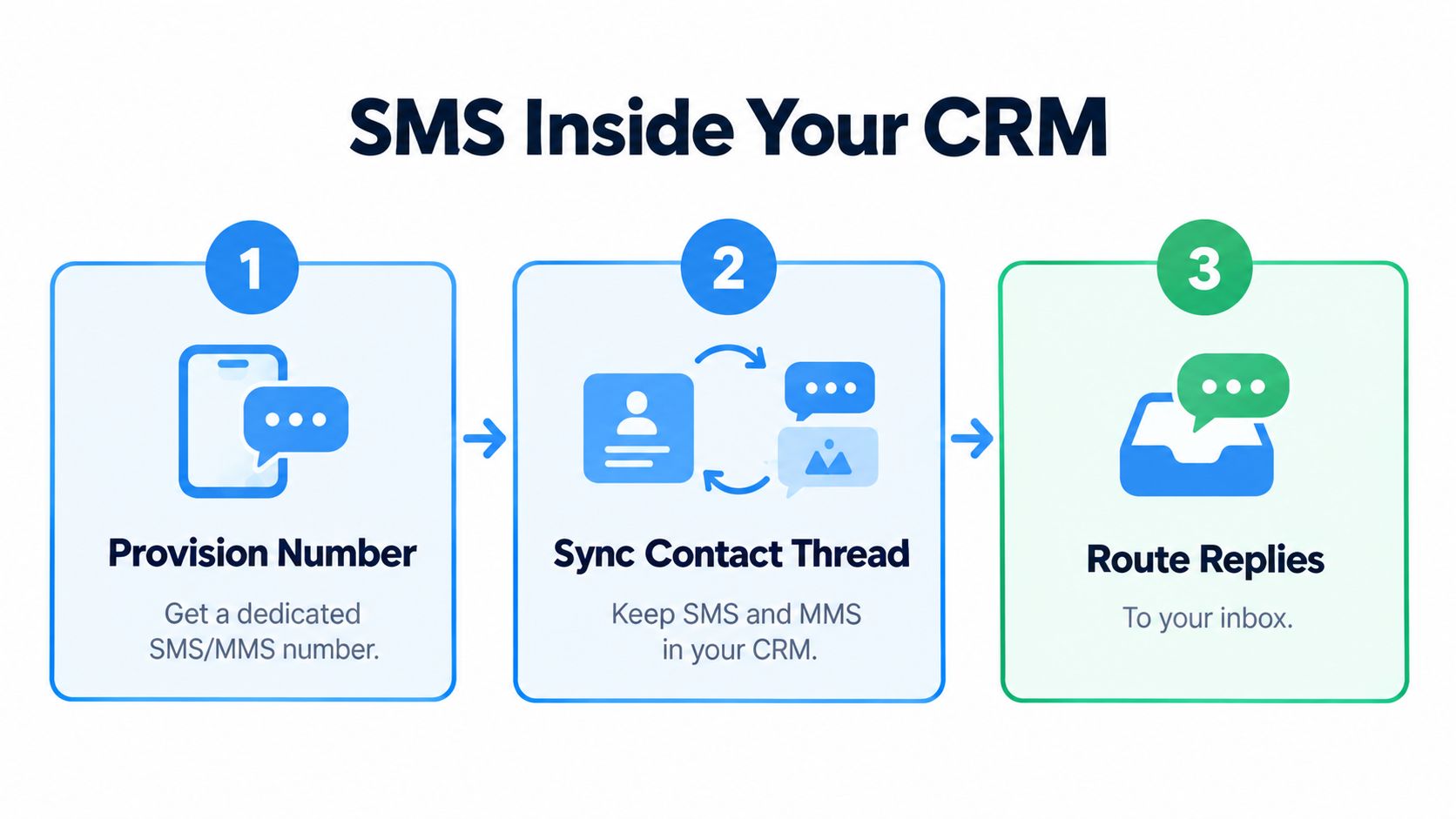
The key is routing those replies to the right person. A business texting platform connected to your CRM ensures every reply lands in the right inbox with full contact context.
3. Personalize outreach based on CRM data
Personalization doesn't mean using a first-name merge tag. It means sending a message that reflects what the person has actually done: visited your pricing page, attended a webinar, opened a proposal, or went silent after a demo.
Your CRM already tracks these signals. Use them. A text that says "Noticed you checked out the Salesforce integration page, want me to walk you through setup?" lands very differently than a generic "Just checking in."
Pro Tip: messages under 100 characters get response rates of 65-68%, while messages over 300 characters drop to 33% or less. Short, specific, and personal wins.
Check out these sales follow-up templates for examples that actually work.
4. Automate follow-up sequences across channels
Most deals and renewals don't die from rejection. They die from silence. A lead ghosts after the first call. A customer doesn't respond to the renewal email. A new user never completes setup.
Here's what the data says: 42% of all SMS replies come from follow-up messages, not the first text (Salesmsg Benchmark Report). Teams that send one message and move on are missing nearly half their potential conversations. The optimal sequence length is 4 to 7 messages.
Build workflows in your CRM triggered by specific events: form fill, missed meeting, trial signup, support ticket closed. A practical sequence: Day 0, trigger an SMS. Day 1, follow-up email with context. Day 3, queue a call task. Day 7, final text. Read more in our guide to SMS marketing automation.
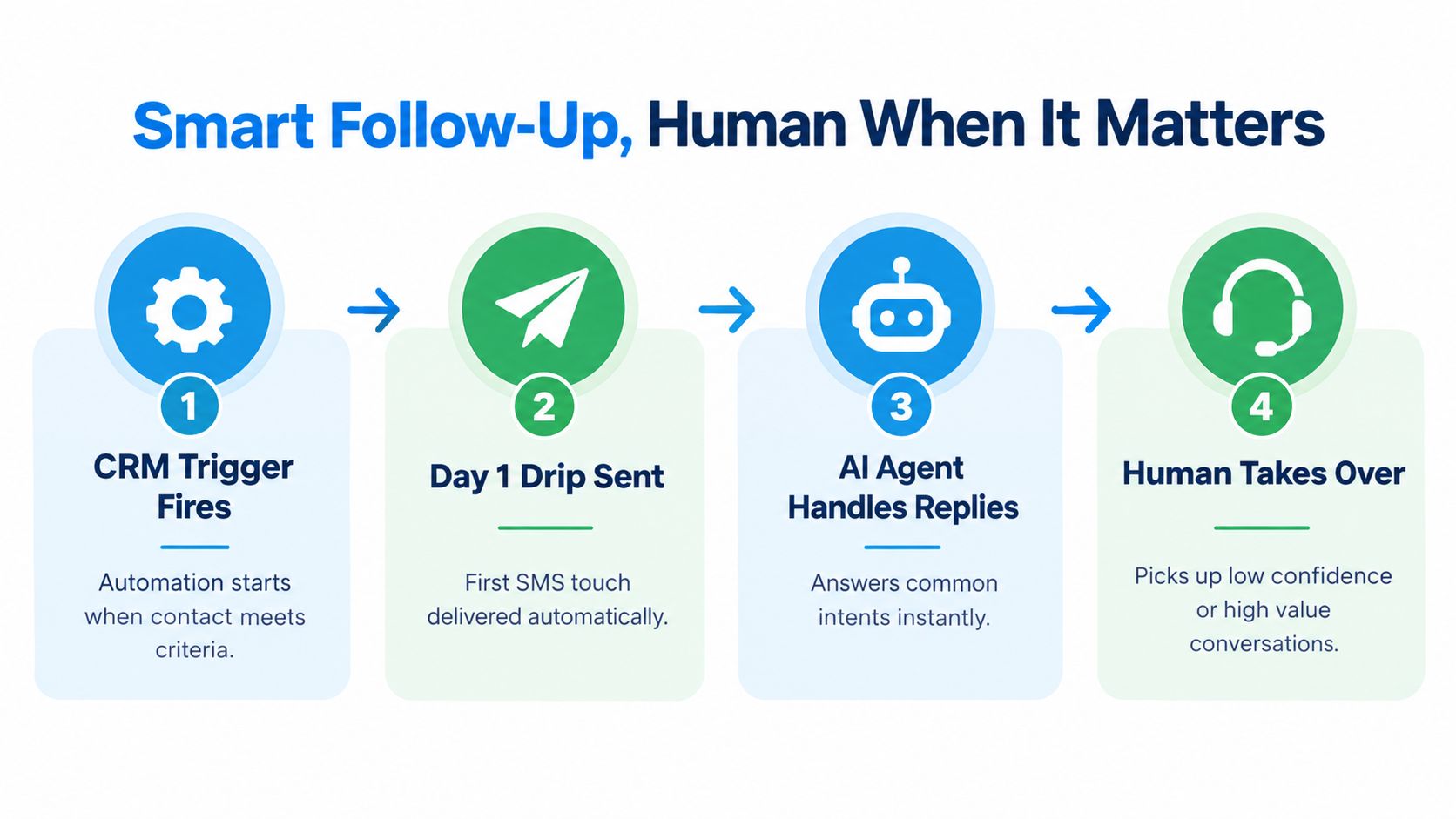
5. Build a shared inbox so nothing falls through the cracks
When a customer replies to a text, who sees it? If the answer is "only the person who sent it" or "nobody, it went to a personal phone," you have an engagement problem that no strategy can fix.
A shared team inbox gives everyone on the team visibility into every conversation. If a rep is out sick, someone else can pick up the thread. If a support question comes in during a sales conversation, the right person can jump in without the customer starting over.
Salesmsg's shared inbox connects directly to HubSpot and Salesforce, so every message, call, and reply is logged to the contact record automatically.
6. Segment your audience by behavior, not just demographics
Sending the same message to your entire database is the fastest way to train people to ignore you. The Salesmsg benchmark report found that 57% of teams say their #1 challenge is maintaining engagement without over-messaging. Segmentation is how you solve that.
Build segments based on what people have done: visited pricing, requested a demo, stopped logging in, opened your last three emails but never replied, or hit a usage milestone. Then tailor the message and channel to that behavior.
For more on this approach, see how to run an SMS campaign that actually targets the right people.
7. Send fewer, better messages
More messages don't mean more engagement. They usually mean more opt-outs. If a customer gets a promotional text, a marketing email, and a sales follow-up all in the same week about different things, you've just given them three reasons to disengage.
The benchmark data is clear: messages under 100 characters get response rates of 65-68%, while messages over 300 characters drop below 33%. Say less. Be specific. Get more replies.
Coordinate across teams. Use your CRM to set frequency caps and check whether a contact has already been messaged before adding them to another campaign. Review SMS marketing best practices for specific rules on timing, frequency, and message length.
8. Use AI to scale personal communication
AI texting agents can handle the repetitive parts of engagement: confirming appointments, answering common questions, qualifying inbound leads, and routing requests, without losing the personal feel.
The numbers are compelling. Salesmsg's benchmark data shows AI agents respond in under 1 minute vs. approximately 15 minutes for a human rep, and produce an 88% lift in response rate. That's not a marginal improvement. That's the difference between winning and losing the conversation.
The key is giving the AI a narrow scope and a clear escalation path. Let it handle scheduling, FAQ answers, and initial qualification. Hand off to a human when the conversation gets complex, emotional, or high-value. Never let an AI agent improvise on pricing, legal questions, or complaints.
For use cases, see our guide to AI SMS marketing, or explore Salesmsg AI Agents directly.
9. Close the loop on customer feedback
Collecting NPS scores and CSAT surveys is pointless if you never act on the results. Customers who take time to give feedback and hear nothing back learn that their input doesn't matter. Next time, they won't bother.
Build a simple workflow: when a customer gives negative feedback, route it to the account owner within the hour. When a customer gives positive feedback, send a thank-you text and ask if they'd be open to a case study or referral. Close the loop fast.
10. Combine SMS and calling for higher engagement
This is one of the most important findings in the Salesmsg benchmark report: businesses pairing SMS with calling see a median engagement rate of 24% vs. 9% for text-only. That's a 2.6x lift just from adding voice to the mix.
A practical combo: send the initial follow-up by text, then call when the prospect replies or clicks a link. Or after a call goes to voicemail, follow up with a text: "Just tried calling, here's a quick link to book a time that works for you." The text makes the missed call feel personal, not random.
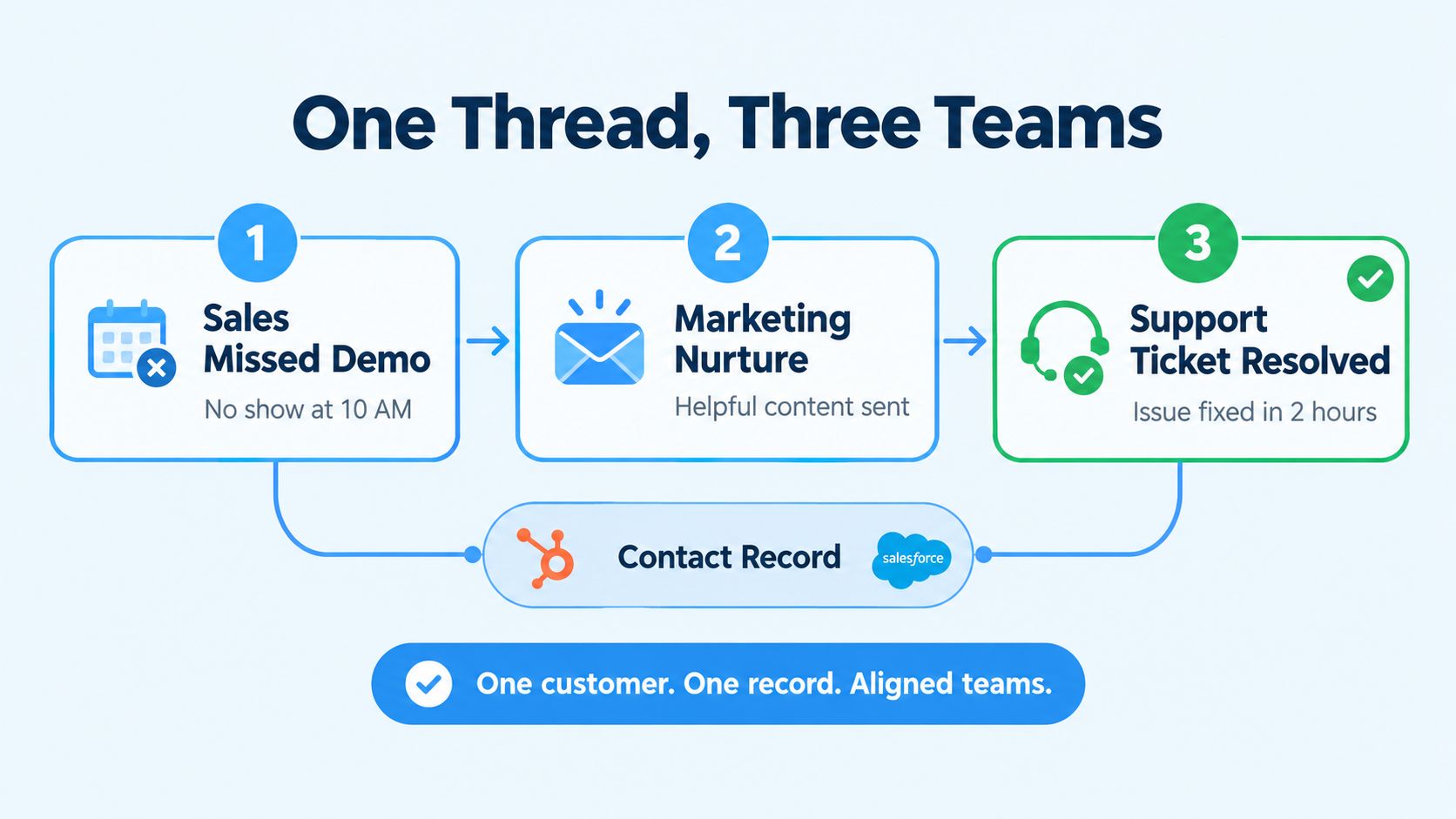
11. Send at the right time
Timing matters more than most teams realize. The Salesmsg benchmark report found that the 10 AM to 12 PM window produces the fastest replies. Response times slow significantly after 6 PM and before 9 AM.
This doesn't mean you should never send outside that window. It means your most time-sensitive messages (lead follow-ups, demo confirmations, booking requests) should land in the 10 to 12 window whenever possible. Schedule your CRM automations accordingly.
12. Track engagement metrics that tie to revenue
Open rates and click rates are activity metrics, not engagement metrics. They tell you a message was delivered and noticed, but not whether it created any business value.
The metrics that matter for B2B engagement are: reply rate (did the customer respond?), time-to-first-response (how fast did your team follow up?), conversation-to-meeting rate (did the exchange lead to something?), and customer retention rate (do engaged customers stay longer?).
Track these by channel and by workflow. The Salesmsg benchmark shows 45% CTR on SMS with links vs. under 5% for email. If you're sending 10x more email than text, you know where to shift effort.
13. Make it easy for customers to talk to you
If a customer has to fill out a support form, wait for a ticket confirmation email, and then wait another 24 hours for a reply, engagement is already dead. Every extra step between "I have a question" and "I got an answer" costs you goodwill.
Give customers a direct line. A business texting number they can save in their phone. A reply-to-this-text option on every outbound message. A way to reach a real person in under a minute. The companies that make it easy to talk to them are the ones customers actually talk to.
14. Re-engage inactive leads with targeted text campaigns
Every CRM has a graveyard of leads that went cold. Before you write them off, try a targeted re-engagement campaign via SMS. A short, direct message referencing what originally brought them in works better than a generic "We haven't heard from you" email.
Example: "Hi [Name], you looked at our HubSpot SMS integration back in June. We've added AI-powered follow-ups since then. Worth a quick look?" Keep it personal, keep it short, and give them one easy action to take.
For ideas, browse these follow-up text message examples built for lead re-engagement.
15. Use call and text from the same number
When your sales team calls from one number and texts from another, customers get confused. They don't know which number to save, which one to reply to, or whether the text and the call are from the same company.
Using a single number for both calling and texting creates a consistent identity. The customer saves one number, and every interaction (call, voicemail, text) shows up in the same thread. It feels like talking to one person at one company, not getting fragmented outreach from three different tools.
Salesmsg lets teams call and text from the same business number, with everything logged to HubSpot or Salesforce automatically.
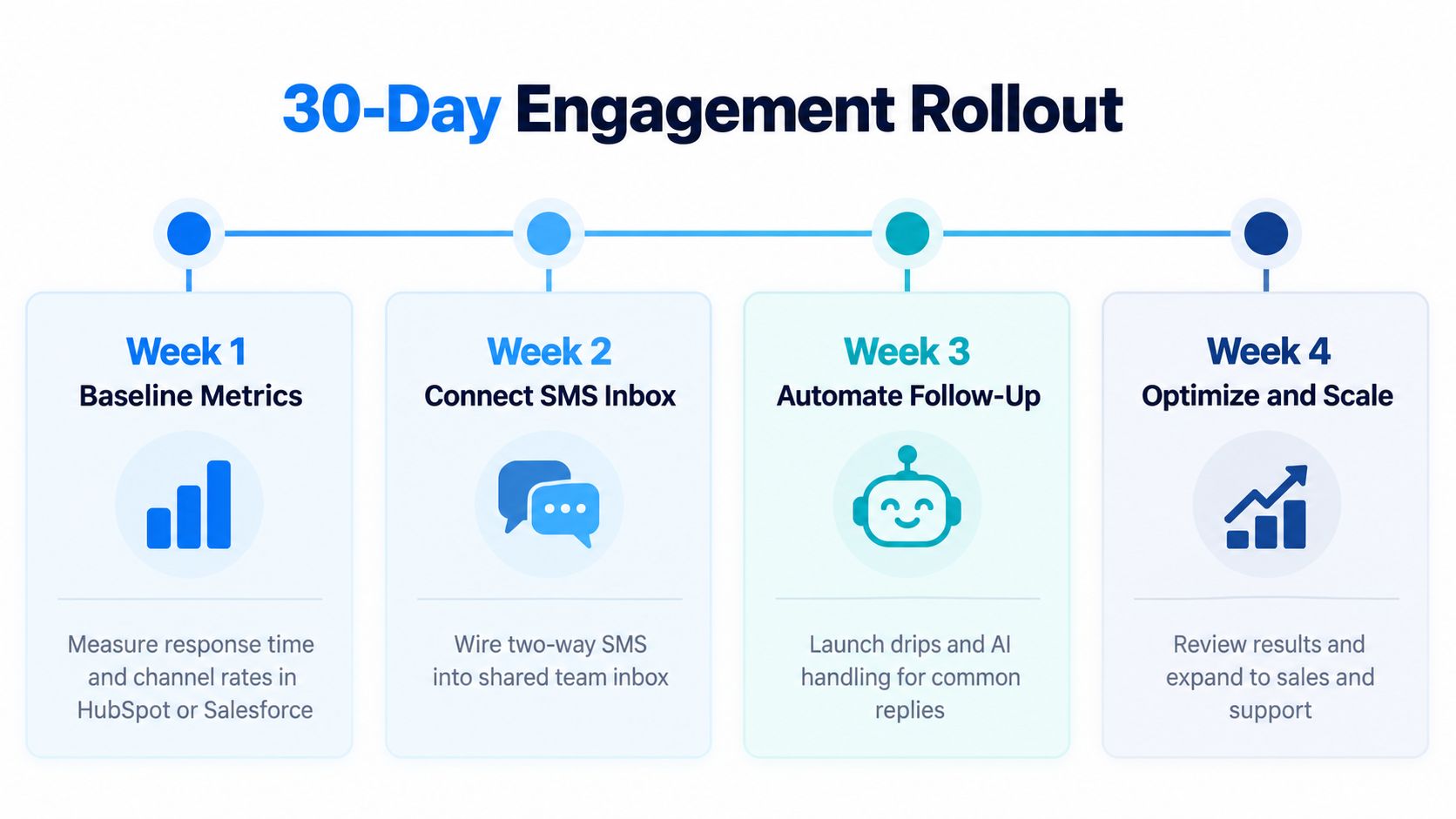
How to measure customer engagement
You can't improve engagement without tracking it, and you can't track it with vanity metrics. Here's what to measure, with benchmark context from the Salesmsg 2026 Benchmark Report.
Run a 30-minute weekly review. Start with reply rate and response time by workflow. Then check opt-outs and unresolved threads. Finish by comparing engaged vs. non-engaged cohorts on retention and revenue.
Common customer engagement mistakes
Blasting your entire database with the same message. A first-time visitor and a three-year customer have nothing in common except that they're both in your CRM. 57% of teams in the Salesmsg benchmark say over-messaging is their #1 challenge. Segment or lose people.
Sending one message and giving up. 42% of replies come from follow-up messages. If your team sends one text and moves on, you're missing nearly half your potential conversations. Build sequences of 4 to 7 messages.
Writing long messages. Messages under 100 characters get response rates of 65-68%. Over 300 characters? Under 33%. Say less, get more.
Using SMS without calling (or calling without SMS). SMS + calling produces a 2.6x engagement lift over text alone. Use both from the same number.
Automating without an escalation path. Automation is powerful until a customer needs a real person and can't get one. Every automated workflow needs a clear handoff to a human.
FAQs
What is customer engagement?
Customer engagement is the ongoing, two-way interaction between a business and its customers across all touchpoints. It includes every conversation, text, email, call, and support interaction that builds the relationship. For B2B teams, engagement usually happens through CRM-connected channels like SMS, email, and phone.
How do you measure customer engagement?
Track reply rate, time-to-first-response, conversation-to-meeting rate, and customer retention rate. According to the Salesmsg 2026 Benchmark Report, outbound SMS gets a 45% reply rate and 45% CTR on messages with links, compared to under 5% for email. Salesmsg tracks these metrics natively inside HubSpot and Salesforce.
What is the fastest way to increase customer engagement?
Respond faster. The Salesmsg benchmark shows that only 14% of businesses have automated their first text to fire in under one minute. AI agents close that gap, responding in under 1 minute vs. about 15 minutes for a human rep, with an 88% lift in response rate.
How does SMS improve customer engagement?
SMS has a 98% open rate with 90% of messages read within three minutes. The Salesmsg benchmark report shows a 45% reply rate on outbound SMS, and businesses that pair SMS with calling see engagement rates jump from 9% to 24%. Platforms like Salesmsg let you send and receive texts from your business number directly inside your CRM.
What are examples of good customer engagement for B2B?
Texting a new lead within two minutes of a form submission. Sending a personalized follow-up after a demo that references what the prospect asked about. Checking in with a customer 30 days after onboarding. Following up a missed call with a text and booking link. These are small, specific interactions that build trust over time.
What is the difference between customer engagement and customer experience?
Customer experience is the overall perception someone has of your brand across all interactions. Customer engagement is the active, two-way interaction that shapes that perception. You can have a good experience passively, but engagement requires both sides participating in a real exchange.
What tools help with customer engagement?
CRM platforms like HubSpot and Salesforce are the foundation. Add a business texting and calling platform like Salesmsg for direct, two-way messaging. Email marketing tools handle automated nurture sequences. The key is connecting these tools so customer data flows between them and every interaction is tracked in one place.
Start improving customer engagement this week
You don't need to implement all 15 strategies at once. Pick the one that addresses your biggest gap. If your team is slow to respond, start with strategy 1. If you're only using email, add two-way SMS (strategy 2). If your follow-up is inconsistent, automate it (strategy 4).
The companies that win on engagement aren't the ones with the biggest martech budgets. They're the ones that make it easy for customers to have real conversations and respond fast when those conversations happen.
Salesmsg connects two-way SMS, calling, shared inboxes, and AI-powered follow-up for teams working in HubSpot or Salesforce. Start a free trial and launch your first engagement workflow in under 15 minutes.

.png)