SMS Marketing Best Practices: 14 Rules Backed by Real Data



_SMS%20Marketing%20Best%20Practices_%2014%20Rules%20Backed%20by%20Real%20Data.webp)

The average person checks their phone 186 times a day. Those numbers explain why the business messaging market is projected to hit $58.5 billion in 2026. This is also why sales, marketing, and support teams have made SMS a core part of how they operate.
To help you get more out of it, we pulled the data from our platform and surveyed 250+ businesses to build the 2026 State of SMS Benchmark Report. The best practices below come straight from that data.
Every practice is backed by real numbers. So, here is exactly what is working in SMS marketing today.
Summary: 14 SMS Marketing Best Practices
1. Get Explicit Consent Before Texting Anyone
Before your team sends a single business text, you need documented permission from the recipient.
The Telephone Consumer Protection Act requires written consent before sending marketing messages to anyone in the US. That consent needs to be specific, clearly worded, and captured before the first text goes out.
Web forms are the most practical way to do this, typically a checkbox with language along the lines of "I agree to receive text messages from [Company]. Reply STOP to opt out."
10DLC registration is also required for any team sending from a 10-digit number in the U.S.
Unregistered numbers face heavy carrier filtering, which means messages get blocked regardless of how well written they are. This is part of setting up your account, not something to figure out after you start sending.
Before building any sequences, check every form, landing page, and opt-in your team uses and confirm consent language is in place.
2. Keep Messages Under 100 Characters
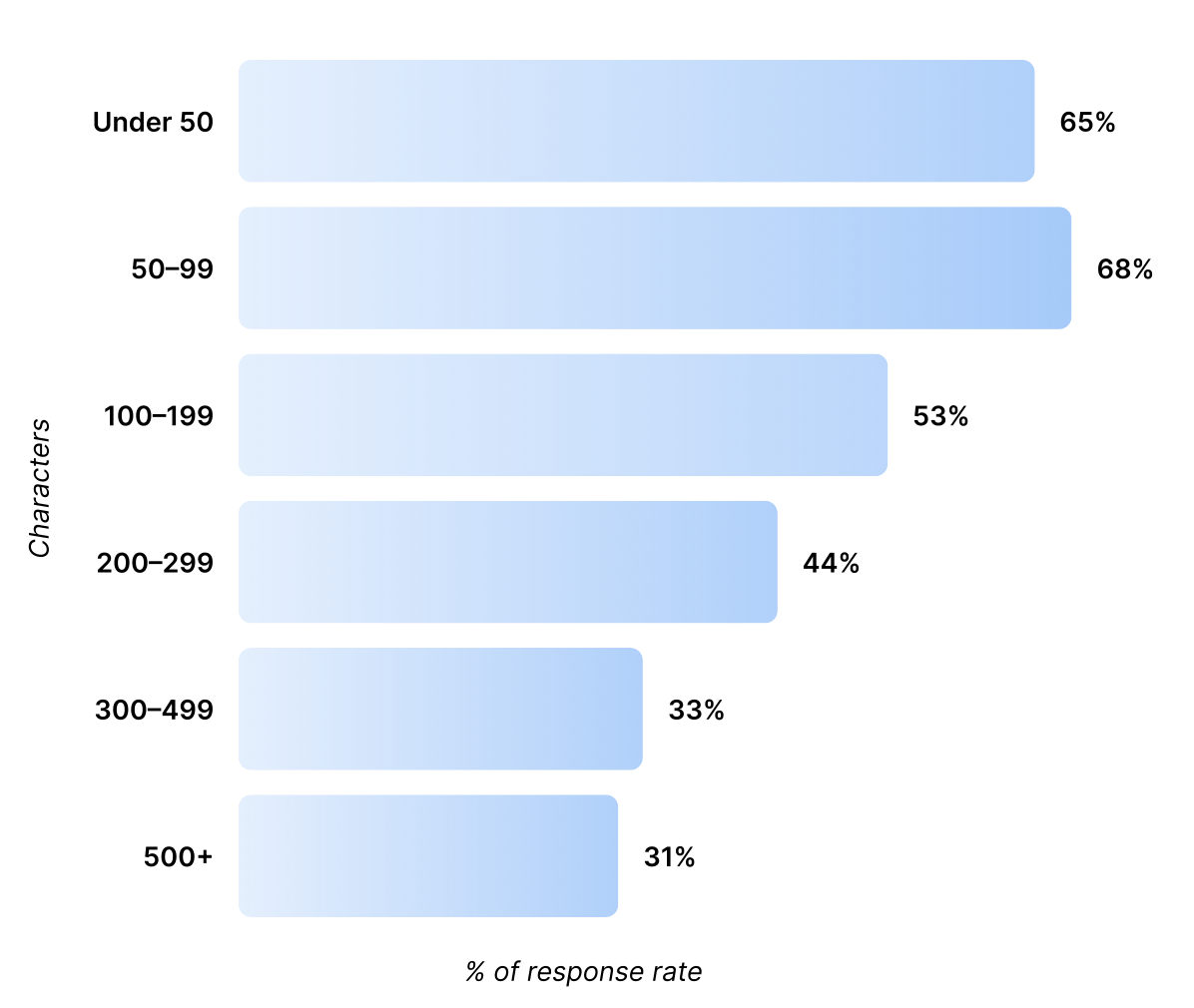
The shorter the message, the higher the response rate. Here’s what the data says:
Messages between 50 and 99 characters produce a 68% response rate. At 100 to 199 characters, that drops to 53%. In the 200 to 299 range, it falls to 44%, and messages over 500 characters land at just 31%.
Sending messages with more content or a longer setup works against you with text messages. A short and clear message with one main goal will outperform a longer message.
If it can’t fit in two short sentences, it probably belongs in an email.
✅ A message that gets replies will look like this:
"Hi [Name], still thinking about the demo? Grab a time here: [link]"
❌ A message that loses replies will look like this:
"Hi [Name], I wanted to follow up because we spoke a few weeks ago and I think given what you shared about your team's challenges with lead follow-up, now might actually be a really good time to revisit the conversation…"
The second message is three times longer and will get fewer than half the responses.
3. Send Between 10 AM and 12 PM
Send time has a big impact on how quickly you hear back. Salesmsg data shows the 10 AM to 12 PM window gets the fastest reply times of the day, going as low as 65 minutes.
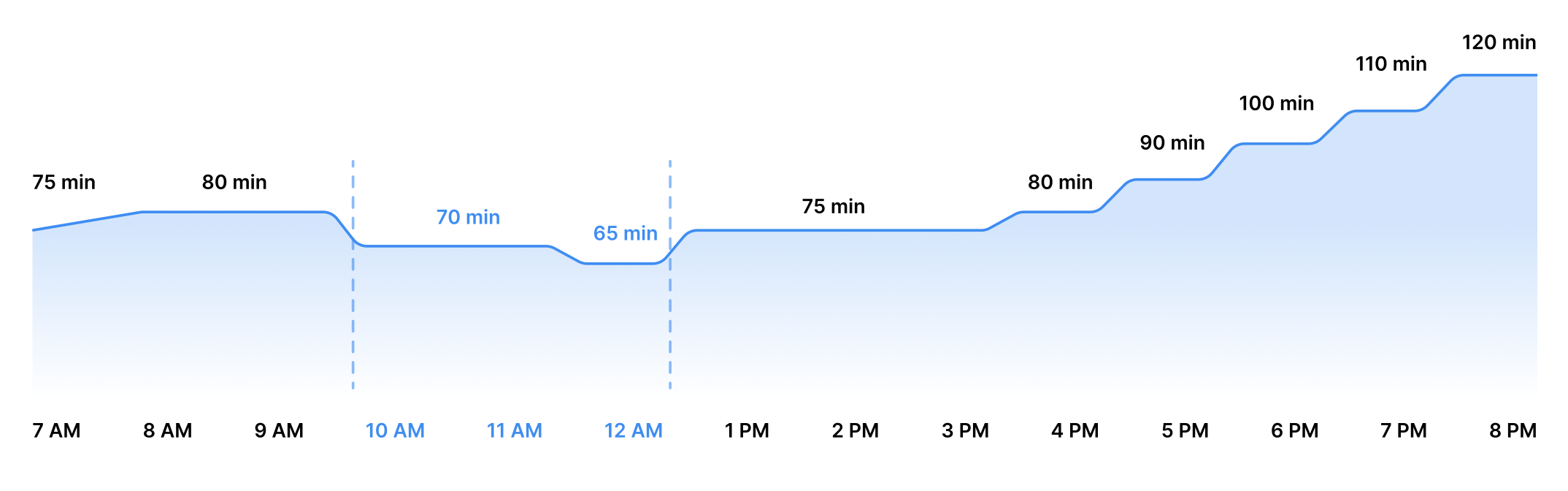
Outside that window, response times climb. By 5 PM, the median sits at 90 minutes, and by 8 PM it reaches 2 hours. Before 9 AM, response times are around 75 to 80 minutes.
This doesn’t mean every text needs to go out before noon. It means your most time-sensitive messages, where a fast reply actually changes the outcome, should be scheduled to land in that window.
For teams running automated follow-up sequences, a small scheduling change can help you consistently get faster replies.
4. Text New Leads Within 5 Minutes
Speed to lead determines whether a conversation happens at all.
57% of businesses send their first text within 30 minutes of a new lead coming in. The top-performing group goes even further: 14% have fully automated their first response. This text goes out in under one minute, completely automated.
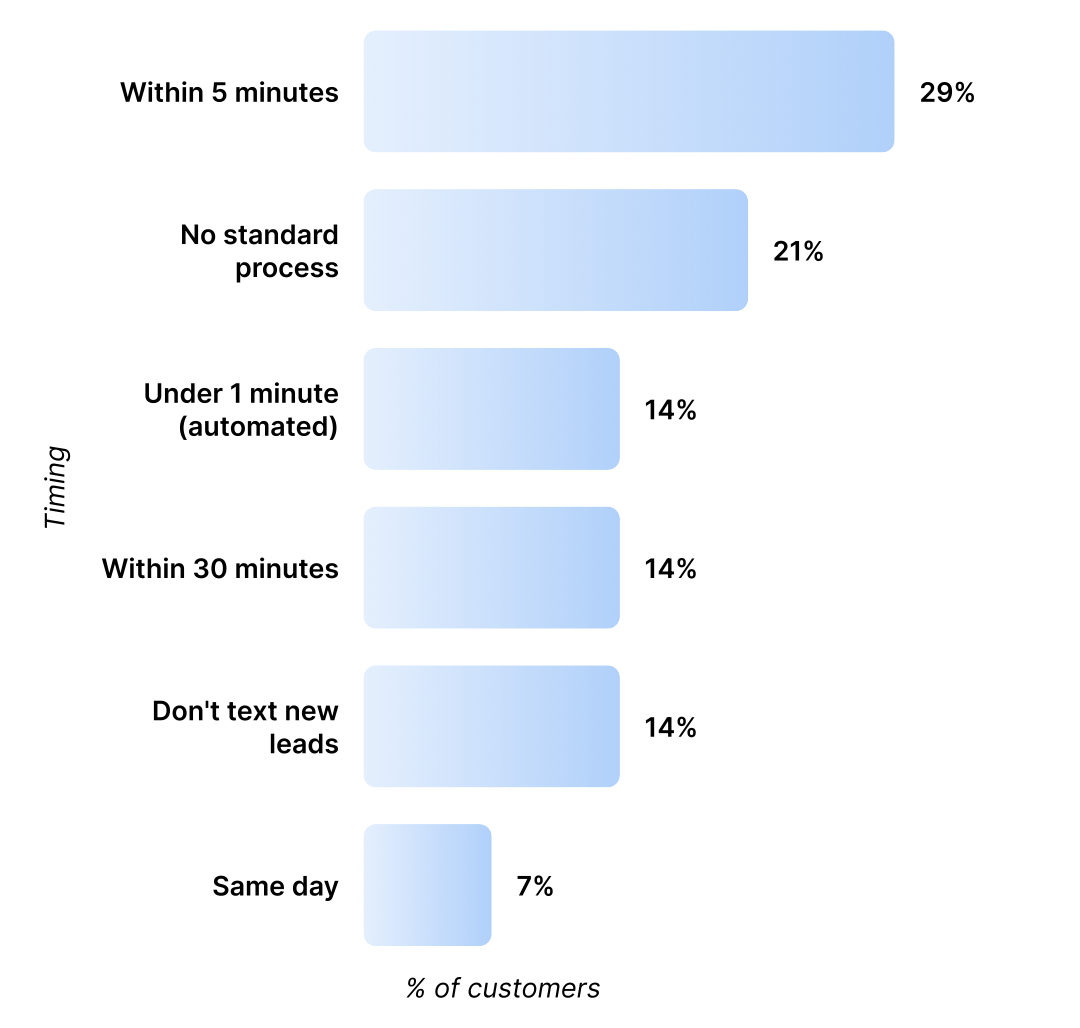
Here’s how this gap in communication time plays out. A lead fills out a form at 10 PM. Without automation, someone on the team notices it the next morning and sends a message around 9 AM. That lead has been waiting 11 hours.
With an automated workflow connected to your CRM, that same lead gets a reply within 60 seconds, before a competitor's team even sees the notification. For most teams, the five-minute window before a conversation takes place is where pipeline is won or lost. AI agents make sub one-minute response times possible at scale.
5. Always Include an Opt-Out
Every broadcast text needs to give recipients a clear way to stop receiving messages.
This is a carrier requirement, not optional language you can skip when a message feels informal. The standard phrasing is "Reply STOP to unsubscribe" and it needs to be in your initial opt-in confirmation and in every broadcast campaign you send.
Opt-out requests need to be honored immediately and automatically so future messages do not go out to that contact.
For one-on-one CRM-triggered outreach, the same principle applies. If a contact asks to stop receiving texts, that preference needs to be captured and respected across your entire system.
6. Do Not Rely on the First Message
Sending one text and moving on is a surefire way to leave replies on the table.
42% of all replies come from follow-up messages, not the first text. Teams that send a single message and move on are walking away from nearly half of their potential conversations.
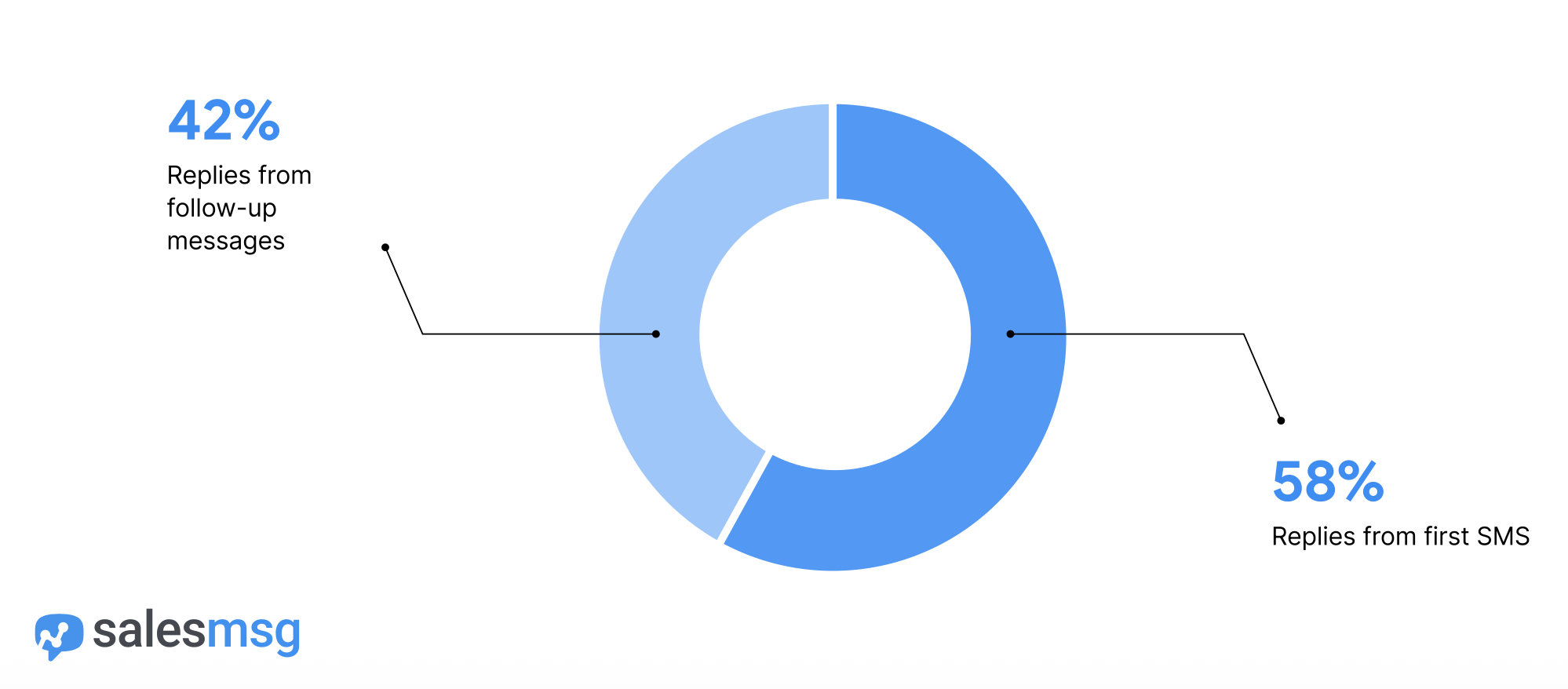
The data shows this clearly:
- 58% of replies come from message one
- 20% require two messages
- 8% require three messages
- The rest are from longer sequences
The optimal sequence length is around 4 and 7 messages. This doesn’t mean you should flood contacts with daily texts.
But, it is a good reason to build automated sequences where each message has a different angle and fires at an interval that makes sense. A four-message flow might look like this:
- Day 1 sends an initial outreach message with a specific question or offer
- Day 3 follows up from a different angle, referencing that the first message went out
- Day 6 delivers something of value, a relevant resource, a short insight, or a case study
- Day 10 closes with a low-pressure final check-in
That kind of sequence runs automatically once it is built and consistently outperforms a single send.
Want the full benchmark data behind these best practices? Get the 2026 SMS Report
7. Personalize Beyond the First Name
Dropping a first name into a message isn’t personalization. It’s the baseline that every team is already doing.
The teams seeing better reply rates are using CRM data to make messages contextually relevant. That means referencing where a contact is in the pipeline, what they downloaded, what industry they are in, or what action triggered the message.
A text that speaks to something real about the recipient reads entirely differently from a generic opener with a name dropped in.
❌Generic personalization sounds like this:
"Hi [Name], just wanted to check in and see if you had any questions!"
✅ CRM-driven personalization sounds like this:
"Hi [Name], saw [Company] has been on our pricing page a few times this week. Happy to walk you through what teams your size typically pay. Want a quick breakdown?"
With Salesmsg connected to HubSpot, Salesforce, and other CRMs, merge fields pull directly from contact records.
First name, company name, deal name, lead source, and any custom CRM field are all available. The more specific the info, the more the message feels like a one-on-one conversation rather than an automated sequence.
8. Connect SMS to Your CRM
SMS works as a tool. When it’s connected to a CRM, it works as a system.
36% of businesses have SMS triggered from CRM workflows. Every text ties directly to a contact record, replies log automatically, and messages send based on real actions rather than a scheduled batch send.
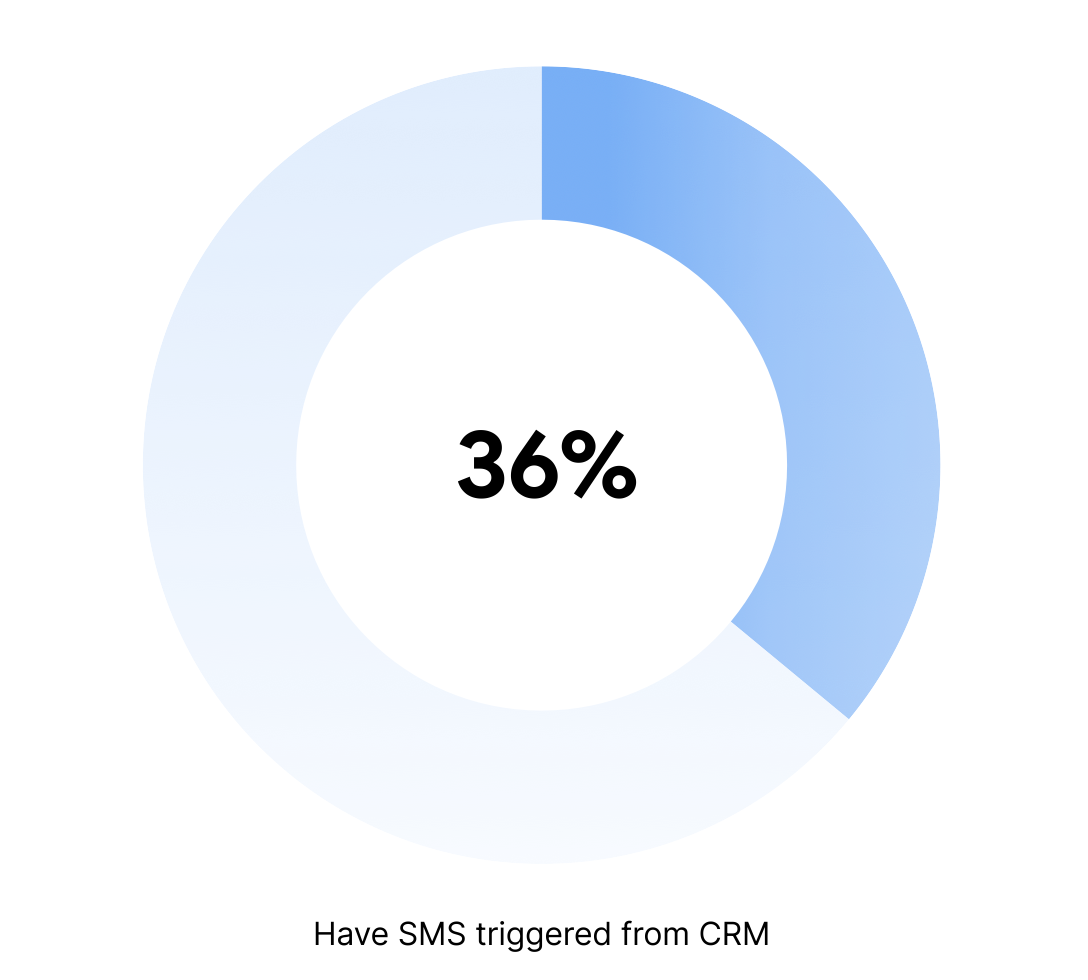
When your CRM workflows are triggering texts, a form submission sends an immediate reply, a deal sitting for 14 days gets a check-in, and a booked demo gets a reminder text the morning of the call.
None of that requires a rep to manually send anything. Teams that have SMS connected to their CRM text differently than teams that don't. The results reflect it.
9. Keep Your Lists Clean and Segmented
Segmenting your list before sending is how you maintain SMS customer engagement without burning through it.
57% of businesses struggle with over-messaging their customers. The real issue isn’t sending too many texts, but it’s sending too many texts to the entire list.
When everyone gets the same text regardless of where they are in the buying process, a big portion of the list finds it irrelevant and even spammy. This leads to opt-outs. And opt-outs shrink the audience you’ve worked to build.
Instead, segment your contacts by deal stage, engagement history, lead source, or buyer type. A lead who downloaded a whitepaper last week needs a different message than a prospect who has been sitting in the pipeline for 60 days with no activity.
The businesses solving the over-messaging problem aren't sending fewer texts. They're sending more targeted messages triggered by actual behaviors, not by a calendar.
10. Add Calling to Your SMS Workflow
SMS alone produces solid results. Pair that with calling, the numbers jump dramatically.
Businesses that combine two-way SMS and calling see a median engagement rate of 24%, compared to 9% for text-only outreach. Average engagement rates move from 23% to 36% when calling is added.
That’s a 2.6x lift just from bringing two channels together. No change to your messages needed. Not only that, but bringing them together is just good business.
A missed call followed immediately by a text from the same number lands differently than two separate outreach attempts from different numbers. Instead, the lead recognizes the number, understands who is reaching out, and can respond in whichever format works best.
Here’s a quick texting a calling workflow worth trying:
- Send a warmup text 10 minutes before a scheduled call to confirm it is still happening
- Follow a missed call with an immediate text from the same number
- Send a short post-call text with next steps while the conversation is still fresh
Each on its own is a small improvement. Running all three together is what produces the 2.6x lift in the data.
11. Test AI Agents for Inbound Lead Response
When a new lead comes in and nobody is available, they form a first impression of your company based on the silence.
AI agents close that gap. Salesmsg data shows AI agents respond to inbound leads in under one minute, compared to approximately 15 minutes for a human rep. That gap in response time produces an 88% lift in response rate.
For teams with a lot of inbound leads, AI handles the first response, asks qualifying questions, and can book a meeting before a human rep even sees the notification.
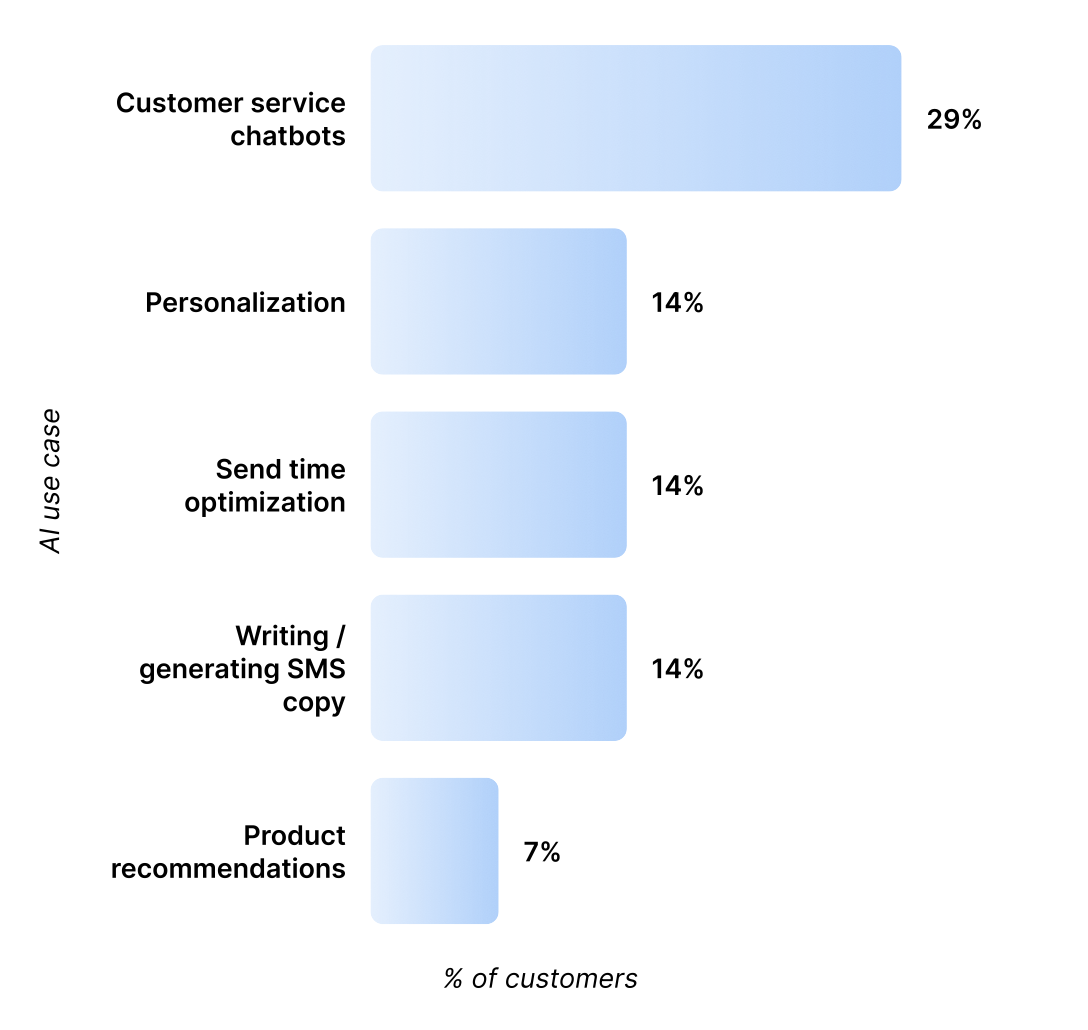
28% of businesses are currently testing or actively using AI in their SMS workflows.
The most common use is handling inbound conversations automatically and qualifying leads before handing them off to the right rep. Businesses doing this now are getting a real head start.
12. Automate Your Highest-Volume Workflows First
Start your automation with the workflows your team is already doing, then grow from there.
The three most common active automation flows from our report are:
- Appointment reminders
- Welcome series
- Lead follow-up sequences
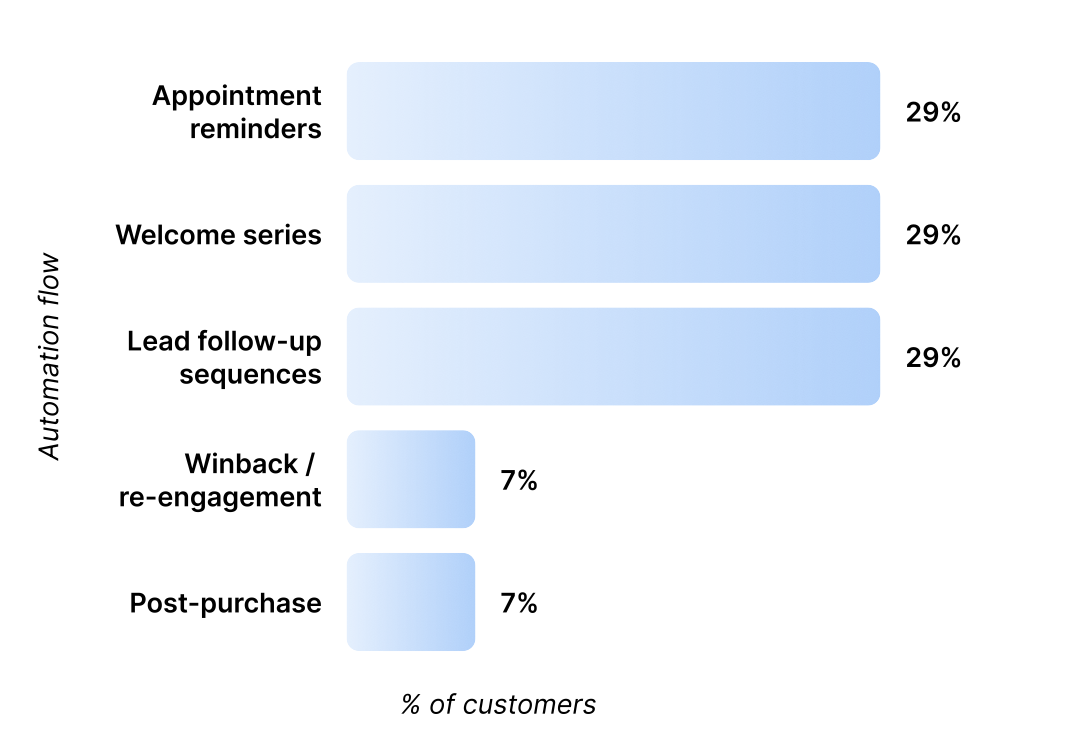
Each of these workflows are running in 29% of businesses we surveyed. These workflows take a lot of manual effort and errors are costly. Because of that, the ROI is clear.
Most teams should start with appointment reminders. Get that running first, then layer in the lead follow-up series. The welcome series comes next.
One of the best practices for SMS marketing welcome series is to keep it simple.
A good welcome series starts the relationship on the right foot, delivers something useful early, and keeps new contacts engaged before they go cold. An opt-in confirmation, something useful in the first day or two, and a soft ask a few days later is enough to make a real difference.
Treating every text as a one-off send is what keeps results inconsistent. Even a basic sequence changes that quickly.
13. Measure What Actually Matters
Benchmarks give you a baseline. Without them, there is no way to know whether a number is strong or whether it means something needs fixing.
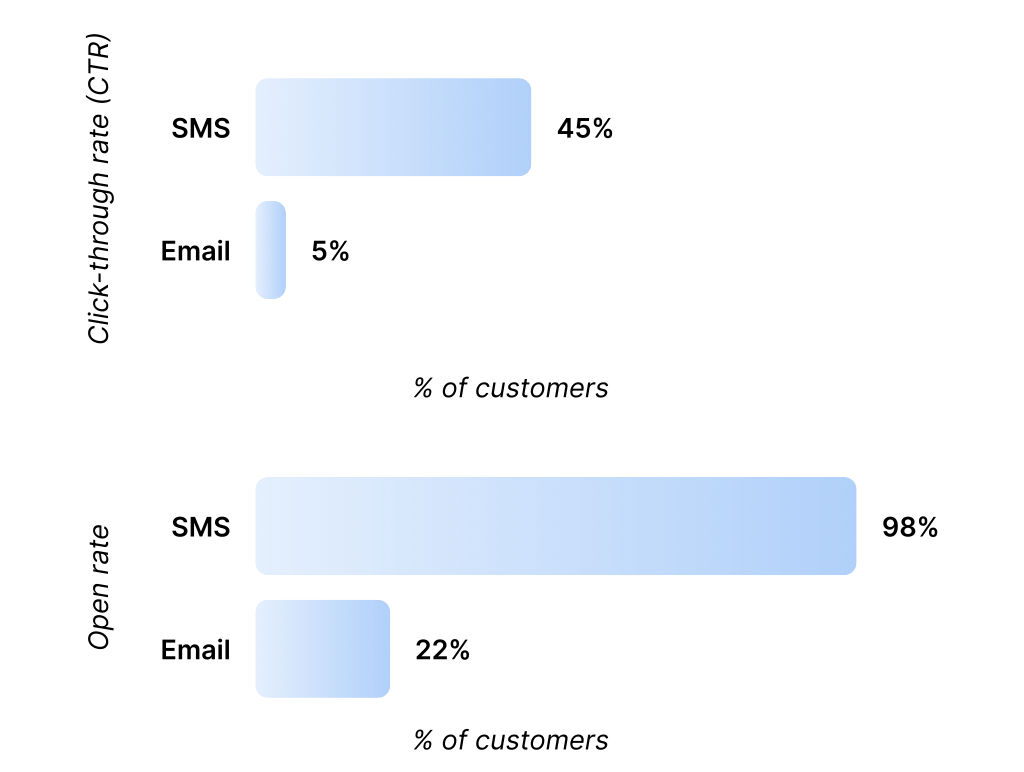
Start with the basics. Our report puts the average CTR on messages with links at 45%, compared to under 5% for email. SMS open rates run at 98%, with 90% of messages read within three minutes.
Reply rate is where most teams have room to improve. The average for outbound replies within 24 hours is 11%. If your team is sitting consistently below 5%, that is a signal to look at message length, send timing, and personalization before sending more volume.
Also track by campaign type, not just in aggregate. An appointment reminder sequence and a cold outbound follow-up series operate differently and need different baselines.
If you track everything in one view, a strong campaign can hide a weak one. You need to see each sequence on its own to know where to actually improve.
14. Fix Compliance Issues Before You Submit
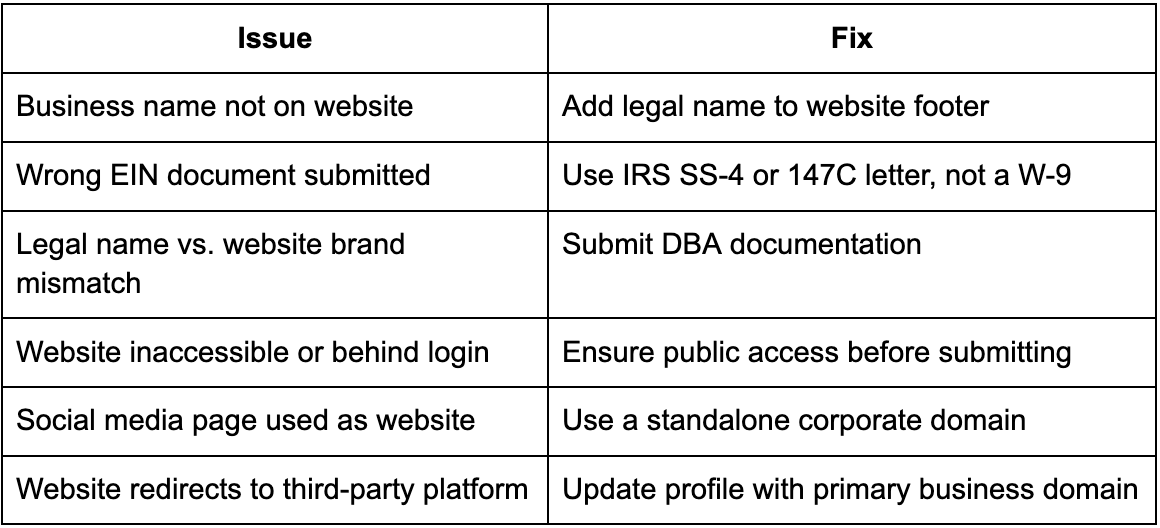
Most compliance rejections aren’t the result of anything fundamentally wrong with your business. They’re documentation problems that could have been caught and corrected before the application was ever submitted.
Looking at all of the business profile submissions in our report shows there are five failure reasons that account for 55% of all rejections.
- Business ID not verifiable accounts for 13.2%
- Authorized rep unverifiable for 12.7%
- Business name and website mismatch for 12.3%
- EIN verification failed for 9.3%
- Address not verifiable for 7.9%
Here’s how you can fix these common issues:
Compliance does not need to be a major source of stress. Getting the paperwork right before submission is the most effective thing you can do to avoid delays.
Put These Best Practices to Work With Salesmsg
All the sms best practices above come from real data from companies just like yours.
Salesmsg gives sales, marketing and support teams two-way texting, a shared team inbox, native CRM integrations, built-in AI agents, automated workflows, and 10DLC compliance tools in one place. There is no separate tool for calling, no separate compliance process to manage, and no manual logging required.
Start a free 14-day trial of Salesmsg and see how your team stacks up against the benchmarks.
SMS Marketing Best Practices FAQ
How often should I send SMS marketing messages?
More than you might think. Data from our benchmark report shows 71% of businesses send multiple times per day. High frequency is fine when messages are triggered by behavior rather than blasted on a schedule. The risk is not volume, it is sending the same message to everyone at the same time.
What is a good response rate for SMS marketing?
The platform average for outbound replies within 24 hours is 11%. If your team is consistently below 5%, look at message length, send timing, and personalization before adding more volume.
Do I need to include an opt-out in every text?
Yes. TCPA requires it and carriers enforce it. "Reply STOP to unsubscribe" is the standard phrasing and needs to appear in your opt-in confirmation and every broadcast campaign you send. Opt-outs need to be honored immediately and suppressed automatically.
What is the best time to send a marketing text?
10 AM to 12 PM. That window produces the fastest response times, reaching as low as 65 minutes at noon. Response times slow significantly after 6 PM and before 9 AM.
How long should an SMS marketing message be?
50 to 99 characters gets you the highest response rates at 68%. If it cannot fit in two short sentences, it probably belongs in an email.
What is an SMS campaign?
An SMS campaign is a sequence of text messages sent to a group of contacts with a clear goal, whether that’s following up with new leads, reminding customers of an appointment, or re-engaging prospects who have gone quiet. The best SMS campaigns are triggered by behavior and connected to your CRM rather than sent as one-off blasts.
What is A2P 10DLC, and do I need it?
A2P 10DLC is the registration process U.S. carriers require for businesses sending texts from a 10-digit number. If you are sending business texts in the US, you need it. Unregistered numbers get filtered and blocked regardless of how good your messages are.
Can I use SMS for B2B sales outreach?
Yes. Get consent before texting, keep messages relevant to where the prospect is in the buying process, and pair SMS with phone calls where you can. Businesses using SMS and calling together see a 2.6x lift in engagement compared to SMS alone.
_SMS%20Marketing%20Compliance.webp)
.png)