What Is Call Forwarding: A 2026 Guide



_What%20Is%20Call%20Forwarding_%20A%202026%20Guide.webp)

Your phone rings. You're already on another call. The caller doesn't reach you. They reach voicemail, or worse, they hang up before it even gets there.
Call forwarding fixes that specific problem. It sends the call somewhere else automatically, so a busy line or an absent person doesn't mean a missed connection. Most people run into it on a personal phone. But once a business relies on it across a team, the same fix starts creating new problems of its own.
This guide covers what call forwarding actually is, the mechanics behind it, the different types you'll run into, how to set it up, the risks nobody mentions, and the point where a team outgrows it entirely.
The moment a missed call costs you a deal
A five-person team starts the morning with a shared inbound number. One rep is speaking with a prospect, another is driving to a client visit, and the support manager is handling an urgent customer issue. The phone system doesn't know which person has the right context. It only knows whether the line is busy, unanswered, or available.
The instinctive response is understandable. Dial a carrier code, forward the office number to a cell, and keep working. Traditional forwarding has been useful for exactly this kind of temporary absence. A field representative can remain reachable, and an after-hours caller can reach someone instead of hearing a dead line.
The problem appears when a team treats that redirect as the entire response process. A forwarded call may land on one person's mobile without telling the rest of the team, and a voicemail may stay in a private inbox. The original number can remain visible to the caller while the destination changes behind the scenes, which makes ownership difficult to reconstruct later. Salesmsg's guide to speed-to-lead response is useful context for teams evaluating how quickly they respond after an inbound inquiry.
Practical rule: Reachability gets a call to a person. Accountability shows what happened next.
For a sales manager, that distinction turns a missed call into a pipeline question. If the team can't identify the caller, assign ownership, and record the outcome, the manager can't reliably coach the handoff or tell whether the lead received a timely response.
What call forwarding means
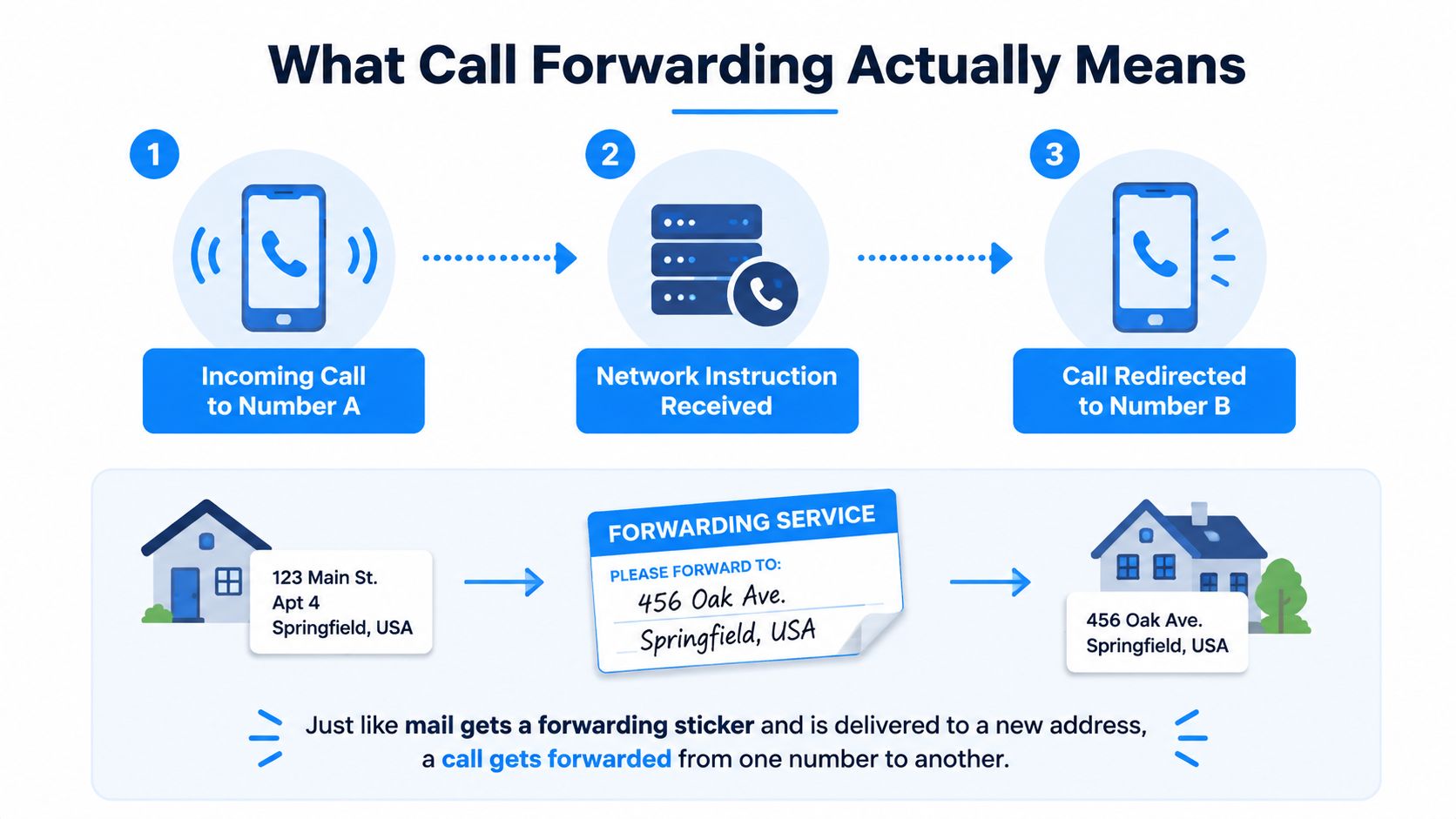
Call forwarding is a network-level instruction. It tells your carrier or phone system where to send an incoming call instead of, or before, ringing the number the caller dialed.
Think of it like mail forwarding. A letter addressed to your old apartment gets intercepted and redirected to your new one. The sender never changes the address they wrote. The postal service just reroutes it. Call forwarding works the same way: the caller still dials your number, but the network delivers the call somewhere else.
What happens on the network
A standard call follows this sequence once forwarding is active:
- The caller dials the original number
- The network checks that number's active call settings
- It finds a forwarding rule (unconditional, busy, no answer, or unreachable)
- The network redirects the call to the configured destination
- A new call leg opens to that destination
In SIP-based systems, this redirect is typically a 302 response, with the new destination listed in the Contact header. In traditional carrier networks, the same redirect happens through SS7 signaling. Either way, the important part is this: your phone doesn't do the forwarding. The network does. Your phone just tells the network which rule to apply.
That distinction matters because it explains why forwarding behaves differently depending on your carrier. Some preserve the caller's original number when the call reaches the new destination. Others replace it. Some log the forwarded leg separately for billing. Others don't. Teams that need consistent inbound handling can compare this with the broader controls available through Salesmsg business calling.
This also explains a common support question: a caller says your business number displayed correctly, but the person who answered saw unexpected caller information. That's not a bug. That's carrier policy on the forwarded leg.
Unconditional vs conditional forwarding
The most important choice isn't the destination number. It's when the network should redirect the call. Unconditional forwarding sends every incoming call away immediately. Conditional forwarding waits for a defined state, such as a busy line, no reply, or an unreachable device.
Carrier codes vary, so confirm the exact activation and deactivation sequence with your provider.
Unconditional forwarding
With unconditional forwarding, the original phone typically won't ring. The network sends the call straight to the selected destination, which makes this mode suitable for a complete handoff, such as an executive routing calls to an assistant, or a field rep away for the day.
The tradeoff is total. The original user loses the opportunity to answer, screen, or provide context before the call moves elsewhere.
Conditional forwarding
Conditional forwarding acts as a fallback. The original line rings first, and the network redirects only after a condition occurs:
- Busy: the original line is already handling another call
- No reply: the line rings without an answer
- Unreachable: the device is offline or unavailable to the network
No-answer forwarding typically depends on ring duration rather than an instant decision. That timing can shape whether a prospect waits long enough to reach a person or abandons the call. For more complex schedules or team assignment rules, Salesmsg smart call flows offer a model closer to programmable routing than a single carrier redirect.
How to turn on call forwarding
The right setup depends on where the rule lives. A carrier code is quick, a hosted PBX exposes more call-handling fields, and a CRM-integrated platform can connect routing to customer context.
Carrier dial codes. Dial the activation sequence supplied by your carrier, enter the destination, and wait for confirmation. After activating, place a test call from an unrelated number. Check whether the original line rings, what caller ID appears at the destination, and whether the receiving device can return the call correctly. Deactivate through the carrier's documented code when the handoff ends, then test again.
VoIP and hosted PBX. An administrator opens the user or number settings and configures the forwarding number, ring timeout, fallback destination, voicemail handling, and caller ID treatment. SIP platforms may use a 302 redirect, a sequential "follow me" list, or parallel ringing.
CRM-integrated routing. Configure the inbound number, select the routing behavior, and connect conditions to contact properties, ownership, or pipeline status. Don't rely on the configuration screen alone. Test a new lead, an existing contact, a busy rep, an unanswered call, and an unreachable destination, and confirm the call record and follow-up task land where the team expects.
Call forwarding vs. smart routing
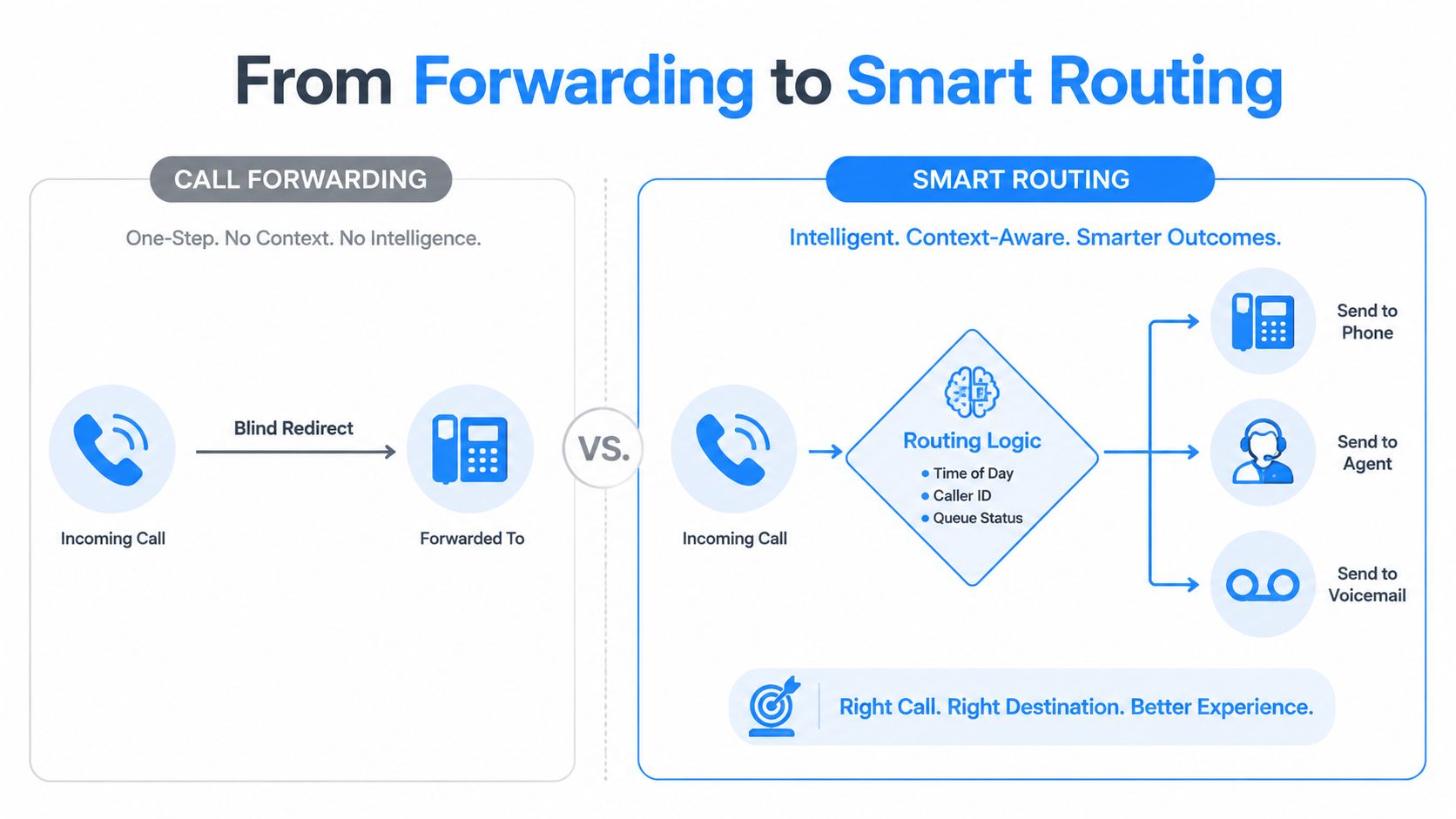
Forwarding and transferring solve different moments in the call. Forwarding is a rule set in advance that runs automatically, often before anyone answers. A transfer is an in-call handoff, started by a person after answering and deciding where the caller should go.
Smart routing adds a decision layer between the incoming call and the destination. Instead of asking only, "Should this number forward?", a routing system can evaluate the caller's identity, time of day, queue status, and CRM ownership before selecting the next step.
Consider two calls arriving on the same business number. The first comes from a new lead tied to a high-value account. The second relates to an open support ticket already assigned to someone. A blind forwarding rule sends both calls to the same destination. Smart routing can send the first toward an appropriate sales rep and the second toward the support owner who already has the account context. That routing model can include:
- Queues: hold callers for an available team member
- Round robin: distribute calls across eligible reps
- Skill or ownership routing: use CRM ownership to guide the handoff
- Voicemail-to-email: deliver the message to a monitored workflow
- AI-assisted triage: direct routine or qualified inquiries appropriately
What forwarding doesn't do for a team
Forwarding solves reachability. It has nothing to say about what happens after the call connects, and that gap shows up in three specific ways.
The first problem is attribution. When an inbound number redirects to a mobile device, the receiving rep may answer without knowing whether the caller is a new prospect, an existing customer, or a partner. If the rep handles the call but doesn't log the outcome, the manager sees a gap rather than a completed interaction.
The second problem is voicemail. A private voicemail box creates a silo. A caller may leave useful buying information, but the rest of the team won't see it until the owner checks the device and shares it, if they're even reachable.
The third problem is distribution. Basic forwarding doesn't provide a practical round-robin queue or skill-based assignment. One rep can receive every redirected call while another has capacity. The destination number answers "where," but not "who should handle this now?"
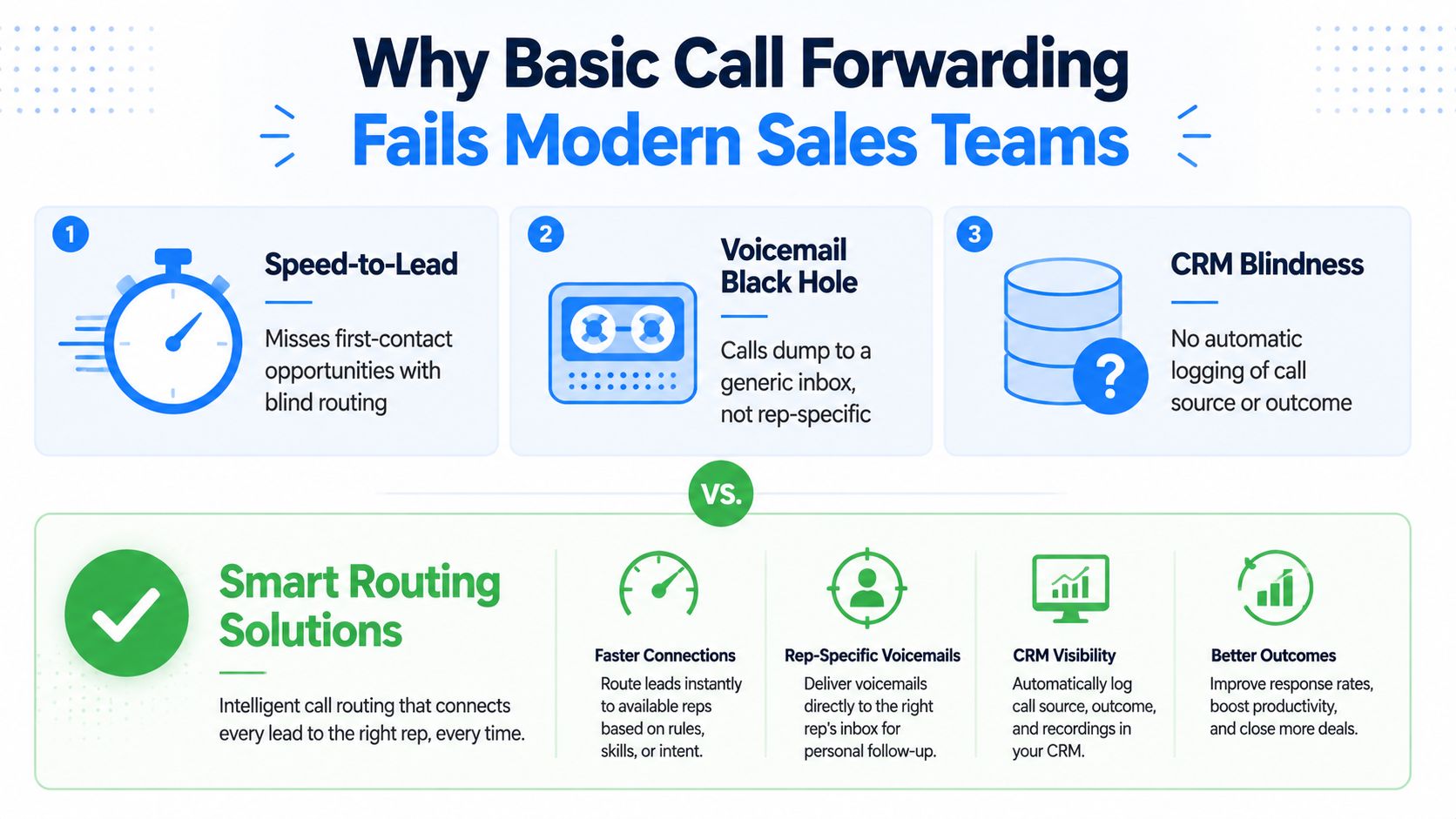
Salesmsg is one example of a platform that combines business calling, shared inbox workflows, CRM-linked routing, conversation logging, and AI agents for qualification or routine inquiries. The call becomes part of a contact timeline, not an isolated event on a handset.
A solo operator only needs a reliable fallback number. Once a second person joins the team, that same number needs a system of record behind it.
Security and billing risks worth knowing
Security. Unauthorized forwarding changes can support social engineering and impersonation. A caller may still see your business number while the conversation has been redirected to an unexpected destination. The risk grows with shared credentials, weak approval processes, or permanent unconditional rules. Restrict who can change forwarding, require confirmation for destination changes, and review active rules as part of offboarding. Teams can use Salesmsg voice compliance controls as a reference point for calling governance.
Billing. A forwarded call commonly involves an incoming leg and an outgoing leg. Depending on the carrier and market, that can affect domestic charges, roaming, international routing, or toll-free treatment. Ask your provider how it bills the forwarded leg before routing calls across borders.
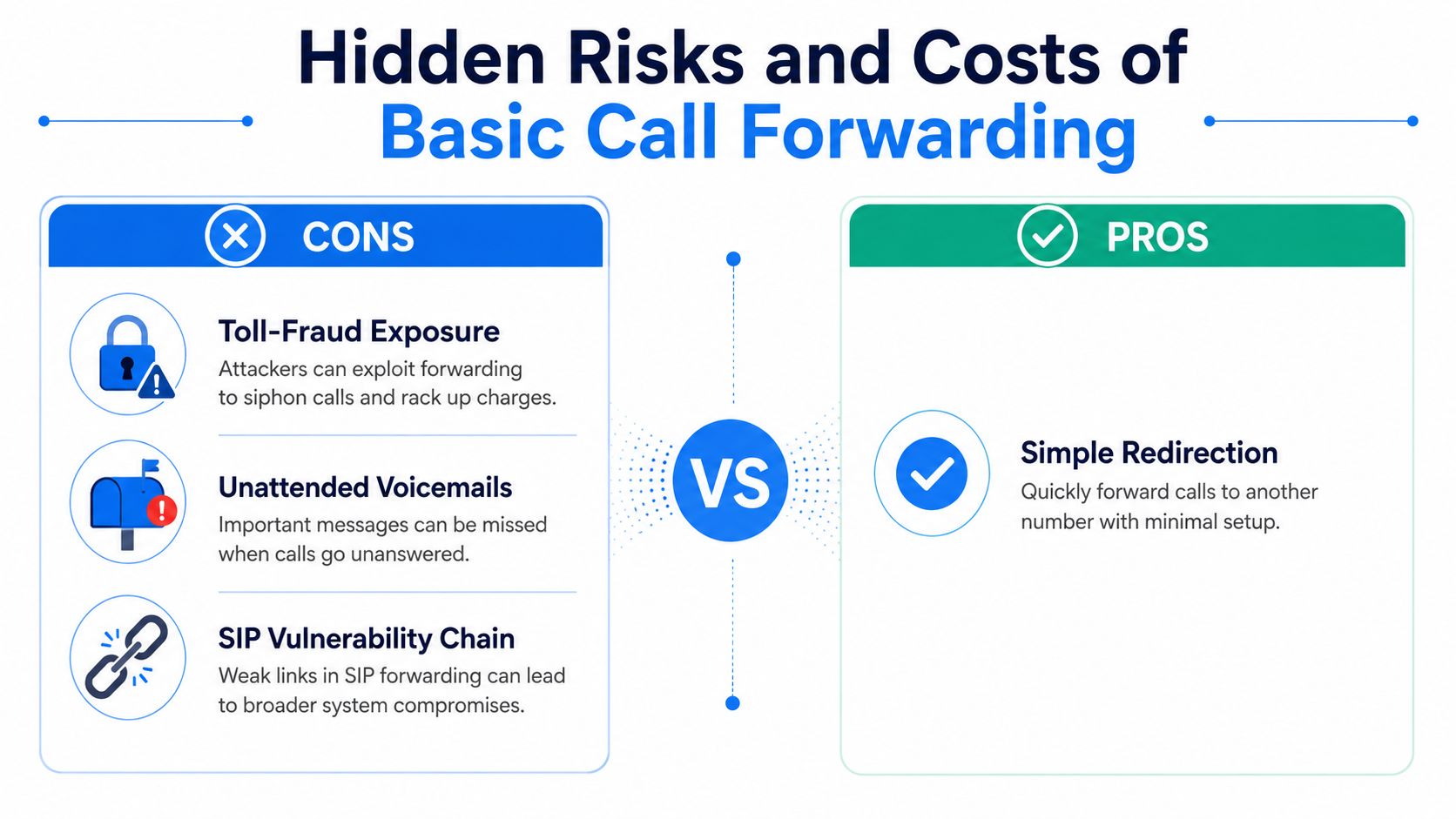
Visibility is the quieter cost. A carrier redirect won't identify the rep who handled the call, attach an outcome to the contact, or give a manager a complete conversation record. A shared inbox, structured call outcomes, and a shared call history view can turn an invisible handoff into an auditable workflow.
This is the gap Salesmsg is built to close. See how Salesmsg handles inbound calls for a team, not just one line.
Best practices and quick troubleshooting
A forwarding rule should be easy to explain, easy to test, and easy to remove. Start with a short audit: every business number, its current destination, who owns the rule, and what condition activates it.
- Whitelist trusted destinations before activating any rule
- Prefer conditional rules over unconditional where possible
- Label each destination clearly: mobile, backup queue, or voicemail
- Check for loops before activating a new rule
- Disable personal forwarding on numbers already in a shared inbox
- Test caller ID from an outside number after every change
- Remove temporary rules once travel or leave ends
FAQs
What does it mean when a call is forwarded? It means the network redirected the call to a different number before or instead of ringing the number the caller dialed. The caller usually has no way of knowing this happened unless someone tells them.
How do I turn off call forwarding? Most carriers use a deactivation code, often built from the same prefix used to turn it on. The exact sequence depends on your carrier, so check their support page directly.
What is the difference between call forwarding and call transferring? Forwarding is a network rule that redirects a call automatically, usually before anyone answers. Transferring happens after a person picks up and manually sends the call to someone else.
Can someone forward my calls without my knowledge? Forwarding rules normally require access to your device or account, but weak security, like shared logins, can make unauthorized changes possible. Check your active forwarding rules periodically to be sure.
Is call forwarding free? It depends on your carrier and plan. Some include it at no extra charge. Others bill the forwarded leg separately, especially for international destinations.
What's a better option than call forwarding for a sales or support team? A CRM-connected platform like Salesmsg routes calls based on who the caller is and who owns that relationship, then logs every call to the contact record automatically, something basic forwarding never does.
Does call forwarding work the same way on every phone? The underlying network behavior is similar, but setup steps and dial codes differ by carrier, and between iPhone, Android, and VoIP or PBX systems.
The bottom line
Call forwarding answers one question: where does this call go? It has nothing to say about who should own it, whether it got handled, or what happens next. For one person, that's rarely a problem. For a team, it's the whole problem.
If your team is still relying on forwarding to cover missed calls, the gap isn't your phone system. It's the lack of a record connecting that call to the person who should actually own it. Start a free trial of Salesmsg and see what call routing looks like when it's connected to your CRM instead of a redirect rule.

.png)