Top 5 SMS Predictions 2027: What Changes for Business Texting




SMS stays the default business channel in 2027, but the rules around opt-outs, carrier registration and AI get tighter, and RCS grows alongside SMS rather than replacing it. Those are our SMS predictions for 2027, and each one below rests on something already dated: an FCC order, a carrier rule, an Apple or GSMA milestone, or an analyst forecast.
SMS predictions 2027: what are the biggest changes?
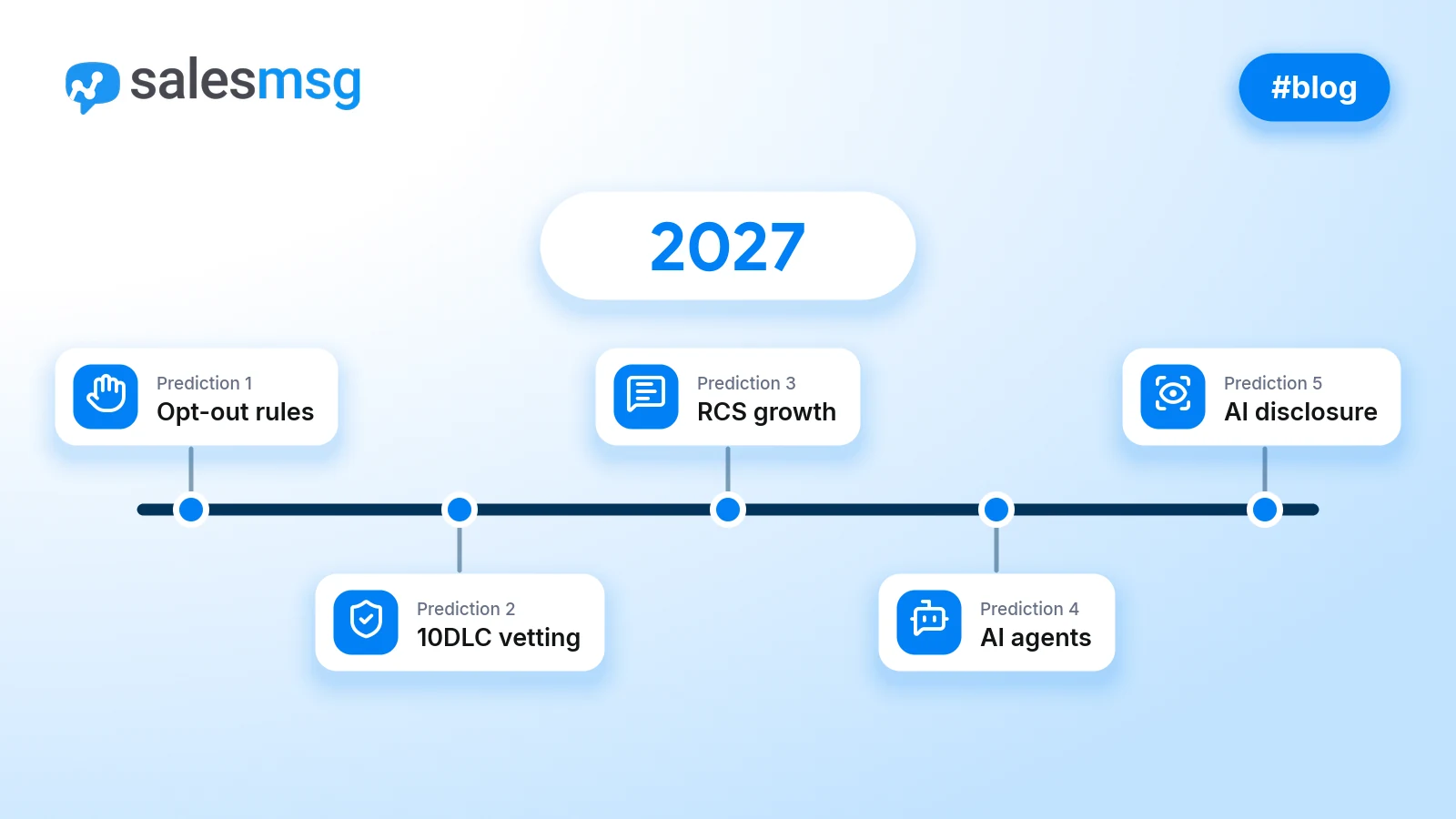
Here are the five, one line each:
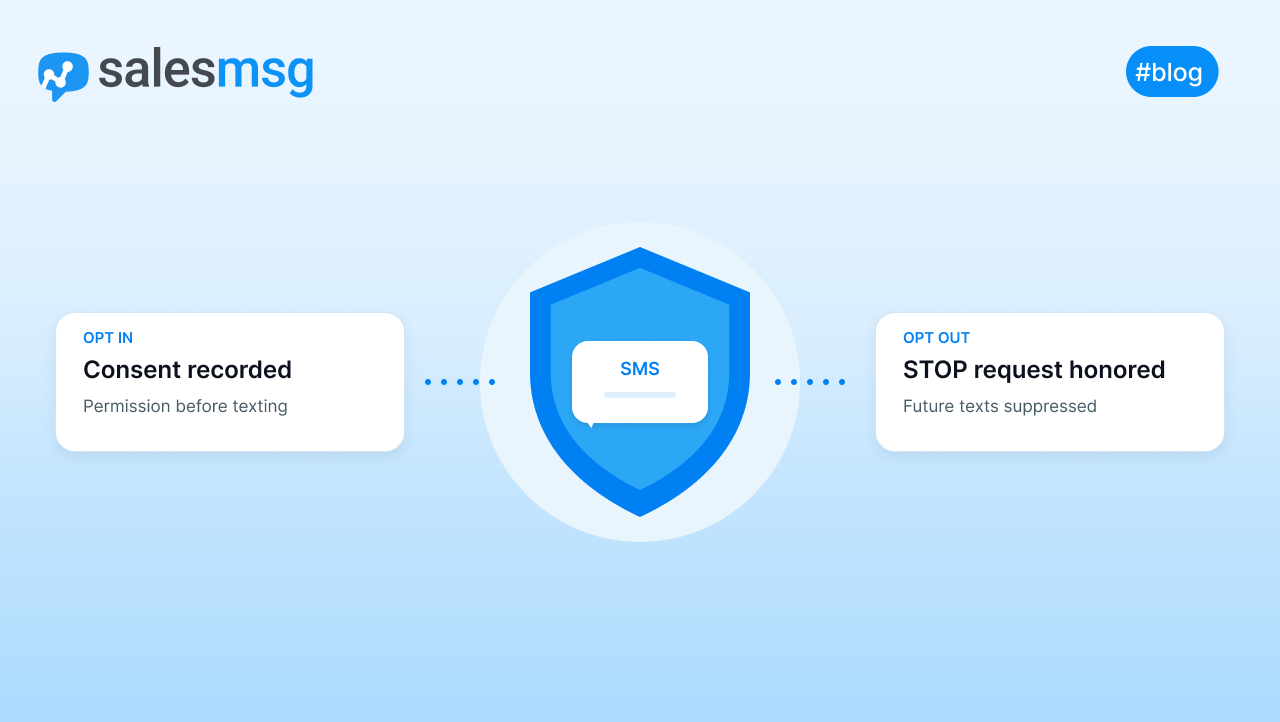
- Opt-outs get more precise: informational and marketing opt-outs split, and the FCC weighs ending one-way texting.
- Carrier vetting decides delivery: your website, privacy policy and opt-in language get checked against what you send.
- RCS grows but doesn't replace SMS: branded messages go to phones that support them, with SMS as the fallback.
- AI agents take the first reply: narrow agents with one job and a hand-off survive, and broad experiments get cut.
- AI disclosure spreads: saying a text comes from AI becomes standard practice, pushed by state chatbot laws and scam fatigue.
How we chose: a prediction made the list only if a dated rule, a published forecast or a shipped product stands behind it. The evidence comes from FCC orders as summarized by law firms, Apple and Google announcements, GSMA Intelligence, Gartner as reported by Reuters, and carrier registration requirements published by messaging providers. In each section, the evidence comes first and our forecast second.
Prediction 1: Opt-outs get more precise, and one-way texting is on notice
The evidence. The FCC adopted a new consent-revocation order on September 30, 2026. It was published in the Federal Register on October 26 and takes effect November 25, 2026, replacing the broad "revoke all" rule that had been delayed to January 31, 2027 (Nelson Mullins). As another law firm put it, the original revoke-all requirement "will never take effect as written" (Ashurst Perkins Coie).
What the order changes for a texting team:
- An opt-out from an informational text, such as an appointment reminder, can be limited to informational texts.
- An opt-out from a marketing text still stops all of that sender's marketing.
- You may name an exclusive opt-out method, such as a reply keyword, if each message discloses it clearly.
- You must still honor the seven standard words: stop, quit, end, revoke, opt out, cancel and unsubscribe.
- Act on every opt-out within a reasonable time, and no later than ten business days.
What did not change: you still need a customer's consent before you text them. The Eleventh Circuit vacated only the FCC's stricter one-to-one consent rule on January 24, 2025, holding that "one-to-one consent is not required" (Kelley Drye).
States are adding their own rules on top. Texas SB 140 now brings text messages under the Texas telephone solicitation law, so many senders may need to register with the Texas Secretary of State and post a surety bond, and private lawsuits are possible (Jackson Walker).
Our forecast. We expect a rulemaking fight over one-way texting in 2027. The FCC's further notice asks whether to shorten the ten-day window (for example to seven business days), eliminate one-way texting or require two-way texting for marketing, and add a one-step "revoke all" option. These are proposals, not rules: comments close November 25 and replies December 28, 2026.
Do now. Label every texting program as informational or marketing, and make sure someone reads and handles replies sent to numbers you only send from. Our guide to TCPA compliance for text messages covers the consent basics.
This is not legal advice. Check your own obligations, including state laws, with counsel.
Prediction 2: Will carrier vetting decide whether your texts arrive?
Yes, and more than your message content does. The evidence. Unregistered 10DLC traffic has been blocked altogether since February 3, 2025 (Telnyx), so registration is now the price of delivery, not a formality.
Review also reaches further into your own website. Starting June 30, 2026, Twilio requires a privacy policy URL and a terms and conditions URL for every new A2P 10DLC campaign registered through its API, because those pages are part of how campaigns are vetted (Twilio).
A May 2026 Holland & Knight analysis describes The Campaign Registry, created by major US carriers in 2020, as the practical enforcement point for CTIA's messaging principles (Holland & Knight). Weak sample messages, disclosures or consent flows can lead to rejection, slower approval, lower trust scores, filtering or blocking.
Our forecast. We expect more rejected and re-submitted campaigns in 2027 for teams whose website, privacy policy and opt-in language don't match what they actually send.
Do now. Audit these four pieces so they all describe the same program:
- The opt-in form: what the customer agrees to receive, and from whom.
- The privacy policy, with a section on text messaging.
- The terms and conditions, with STOP and HELP instructions.
- The sample messages in your campaign registration.
If you text through Salesmessage, see how 10DLC registration works on the platform before you re-check your campaign.
Prediction 3: Will RCS replace SMS in 2027?
No. RCS grows fast, but SMS stays the fallback that every phone can receive.
The evidence. GSMA Intelligence estimates 3.2 billion RCS messages were received worldwide each day at the start of 2026, and forecasts adoption growth of 25% in 2026 and 38% in 2027 (GSMA). Google said in May 2025 that more than a billion RCS messages a day were sent in the US (MacRumors).
iPhone is no longer the blocker it was. iOS 18.1, released in late October 2024, added RCS business messaging on iPhone, though each carrier has to enable it, and recipients without support fall back to SMS (Twilio). On May 11, 2026, Apple began a beta of end-to-end encrypted RCS on iOS 26.5 with supported carriers and the latest Google Messages (Apple).
The GSMA itself notes that RCS for Business is still a relatively small share of all RCS traffic.
Our forecast. We expect more businesses to send branded, verified RCS messages to the phones that support them in 2027, with automatic SMS fallback for the rest. RCS is an upgrade path, not a replacement.
Do now. Decide which messages gain from rich content, such as appointment confirmations with buttons or product cards, and keep SMS copy that works on its own. For the differences in detail, read our comparison of RCS vs SMS.
Prediction 4: AI agents take the first reply, and the weak ones get cut
The evidence. According to Gartner, as reported by Reuters on June 25, 2025, more than 40% of agentic AI projects will be canceled by the end of 2027 because of escalating costs and unclear business value (Reuters via The Star). The same Gartner forecast says 33% of enterprise software applications will include agentic AI by 2028, up from less than 1% in 2024.
Our forecast. We expect AI agents that answer, qualify and book over text to become normal in 2027, and the year to sort useful agents from experiments. The ones that last will have one job, work from the business's own knowledge, and hand off to a person when the customer is ready to buy or upset.
A plumbing company, for example, might give its agent a single task: reply to every missed call, find out what's wrong, and offer the next open slot. We also expect buyers to judge texting agents on booked meetings and resolved conversations, not on how many messages they send.
Do now. Set up one agent in three steps:
- Pick one conversation the agent should own, such as replying to missed calls or qualifying new leads.
- Write the hand-off rule: which questions, keywords or signs of frustration send the thread to a person.
- Measure one outcome, such as meetings booked or conversations resolved without a hand-off.
If you text through Salesmessage, see what AI agents for texting can handle before you choose the agent's one job.
Prediction 5: Will businesses have to say when a text comes from AI?
More often, yes, and trust becomes the reason to say it even where no law requires it.
The evidence. A wave of state chatbot laws requires clear, up-front disclosure that a person is interacting with an AI system. Washington and Oregon require it for companion chatbots from January 1, 2027, and Idaho and Nebraska laws covering conversational AI take effect July 1, 2027 (Orrick).
Be precise about scope: most of these laws target companion chatbots or conversational AI services, not every business text. None of them makes AI disclosure a blanket requirement for SMS today, so treat this prediction as the direction of travel and check with counsel whether any law covers your use.
Scams push in the same direction. People reported $470 million in losses to text scams in 2024, more than five times the 2020 figure, according to the FTC.
Our forecast. We expect three habits to become standard practice in 2027: an AI disclosure line, the business's name in every message, and verified RCS sender profiles. Customers who have learned to distrust unknown numbers will, we think, favor senders who say who they are.
Do now. Write the disclosure line and the hand-off keyword before the agent goes live. For example:
You're texting with Northside Plumbing's AI assistant. Reply AGENT anytime to reach a person.
How should your team prepare for SMS in 2027?
Five actions, one per prediction:
- Map every texting program as informational or marketing, and route replies from one-way numbers to someone who answers them.
- Check your privacy policy and terms URLs, opt-in form and sample messages against the campaign you registered.
- List the messages that would gain from RCS, and keep a plain SMS version of each one.
- Give one AI agent one job, a hand-off rule and one metric.
- Add an AI disclosure line and a keyword that reaches a person.
Whatever the channel, consent and a clear reason to text still decide whether SMS works. For the lifecycle framework behind these changes, read SMS marketing trends in 2026, then start on item 1 this week: it costs nothing and touches every rule above.
FAQs
Is SMS marketing dying?
No. SMS remains the channel every mobile phone can receive, which is why RCS business messages fall back to SMS when a phone or carrier doesn't support them. What is changing is the rulebook: tighter opt-out handling, required 10DLC registration and growing expectations around AI disclosure. Teams that keep consent clean and messages useful keep getting results.
Does the FCC one-to-one consent rule apply in 2027?
No. On January 24, 2025, the Eleventh Circuit unanimously held that the FCC exceeded its authority and vacated the one-to-one consent rule, so it does not apply. General TCPA consent requirements still do, and some states, such as Texas with SB 140, have added their own obligations for texts. Check your situation with counsel.
What does a 'Reply STOP' message have to cover under the new FCC rules?
Tell people how to opt out in every message. If you name one exclusive method, such as replying STOP, disclose it clearly. Still accept stop, quit, end, revoke, opt out, cancel or unsubscribe even if you name a different keyword, and stop texting them within ten business days. The FCC order behind these rules takes effect November 25, 2026.
Do iPhones support RCS business messaging?
Yes. iOS 18.1 brought it to iPhone in late October 2024, but only where the person's carrier has switched the feature on. Otherwise the message arrives as an ordinary SMS. Apple's encrypted RCS beta, which began May 11, 2026, needs iOS 26.5, a carrier that supports it and the newest Google Messages.
What happens if my 10DLC campaign isn't registered?
Your texts from that number won't be delivered. Telnyx says all unregistered 10DLC traffic has been blocked since February 3, 2025. Getting registered isn't the end of it either: reviewers read your opt-in flow, sample messages and disclosures, and a weak submission can be rejected, approved slowly, given a low trust score, or filtered later.
Should a small business switch to RCS now?
Not as a replacement. Keep SMS as your base, because it reaches every phone, and add RCS where a richer message earns its place: a booking reminder with a confirm button, say, or a card showing a product. Write every rich message so a plain-text version still makes sense, since phones without RCS support get SMS instead.