SMS Marketing Pricing: What It Actually Costs in 2026



_SMS%20Marketing%20Pricing.webp)

SMS marketing costs most B2B teams between $25 and $500 per month. Per-message rates run from $0.0083 on a raw API up to $0.05 on a fixed-plan platform.
Your total bill will depend on how many users you have, the number of messages you send, and whether you've handled 10DLC registration.
As you’ll learn, there are a few different pricing models available and choosing the wrong one can double your bill for the same texting volume.
This guide breaks down what each pricing model actually costs, how seven major platforms compare, where 10DLC and compliance fees fit, and how to figure out the right plan for your team's size.
SMS Marketing Pricing at a Glance
Here's how the platforms we'll cover stack up at their entry tiers. Pricing is current as of May 2026.
sms-marketing-pricing
How SMS Marketing Platforms Price Their Plans
Almost every SMS platform on the market uses one of four pricing approaches. Here's how they break down.
Pay-Per-Message
This is the simplest model. You pay for every text sent, with rates that drop as volume goes up.
Twilio is the best example. Rates run roughly $0.0083 per SMS segment in the US, plus per-number rental and carrier surcharges. Send 10,000 messages and you'll pay around $83 in raw messaging fees, plus another $30 to $50 in carrier pass-through costs.
Pay-per-message looks cheapest on paper, and for high-volume senders with engineering teams, it usually is. But the price hides the reality of what needs to happen before you can start sending. You're building the interface, contact management, analytics, compliance handling, and CRM sync yourself.
For most sales teams, cheaper per message stops being cheaper once you factor in development costs and time.
It works best for two kinds of teams. An engineering team building SMS into a product, or a finance team sending high-volume one-way notifications where every cent matters.
Monthly Credits and Message Bundles
The most common model for marketing-focused platforms. You pay a fixed monthly fee for a pre-set number of message credits, with overages billed separately.
Here's how it looks across a few platforms:
- SimpleTexting starts at $39/month for 500 credits (3 user seats included)
- Textedly's Bronze plan costs $49 and includes around 1,200 monthly messages
- Klaviyo's email + SMS combined plan is $35/month for 1,250 SMS credits
Credits are predictable, which is the main appeal. You know what you'll pay next month before you send a single text.
The downside is that unused credits usually don't roll over. And overages get expensive fast. If your volume is uneven (heavy in Q4, light in Q1), you're either overpaying in the slow months or stuck on a higher tier than you need.
Bundle pricing works well for teams sending broadcasts to lists. It works less well for teams who need ongoing two-way conversations, because every inbound reply burns a credit too.
Bundled All-in-One Plans
Bundled plans bring together the phone number, a user seat, and a monthly credit allocation into one base price.
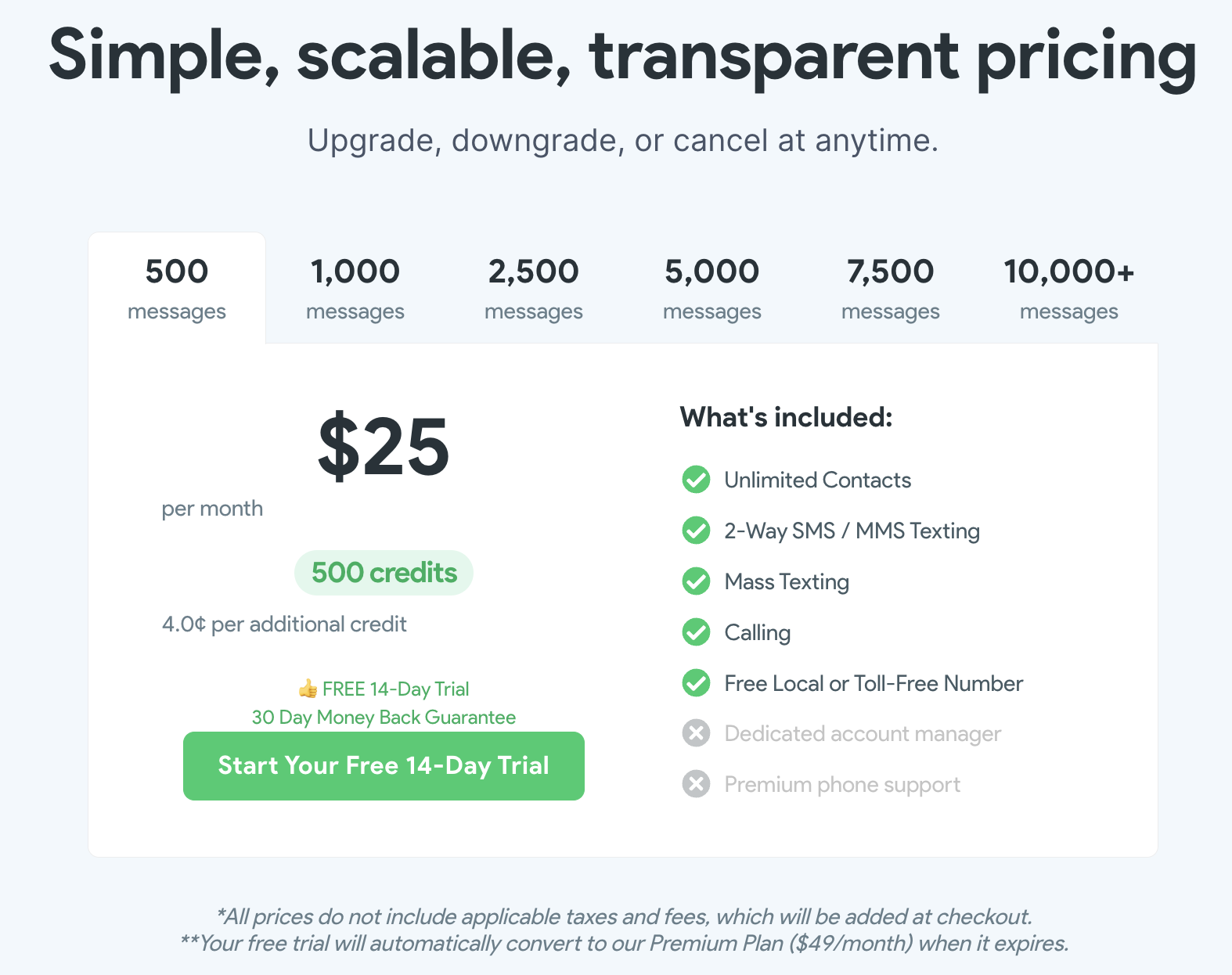
Salesmsg works this way. The starter plan is $25/month for 500 credits, and that includes one local or toll-free number plus one user seat. Additional seats are $10/month each and additional numbers are $5/month per number. Calling minutes are included.
This is the model that fits B2B sales, marketing, and support teams the best because the line items that surprise teams on other platforms (extra users, separate calling tools, separate compliance fees) are already inside the base price.
The math works in your favor when your team needs SMS, calling, and CRM integration in one place.
To compare, a five-rep team on Salesmsg pays the base plan plus $40 for the extra four seats. The same team on SimpleTexting pays $39 base for 3 seats plus $40 in extra-user fees for the additional two, before adding a separate VoIP tool.
Usage-Based and Overage
Most credit-based plans switch to usage-based pricing once you exceed your included volume. Overage rates typically range from $0.025 to $0.06 per SMS, depending on the platform.
Textedly's overage is around $0.05 per text (for a 500 message bundle) after your initial bundle is used. SimpleTexting charges around $0.055 per excess credit.
Usage pricing is fine in small doses. It becomes a problem when it's the bulk of the bill, which signals you're on the wrong plan and should size up.
What Factors Affect Your SMS Marketing Cost
Most pricing tables show one number. But, your actual monthly bill is built from six layers, and missing one of them is how teams end up paying twice what they planned.
How visible each layer is on your invoice depends on the platform:
- Raw APIs like Twilio expose every fee transparently as its own line item.
- Credit-based platforms like Salesmsg pass carrier fees through at cost with no markup, billed separately from the monthly credit plan.
- Ecommerce add-ons like Klaviyo and Mailchimp blend carrier costs into the per-credit SMS rate, so you see one number.
SMS vs MMS rates
Standard SMS in the US runs $0.0083 to $0.05 per message, depending on the platform. MMS messages (anything with an image, video, or longer text) cost three to five times more.
A campaign with an image attached can quadruple in cost without you noticing. That's a frequent shock on the first invoice after a holiday push.
Number type: local, toll-free, or short code
Local 10-digit numbers are the cheapest option and the standard for B2B sales conversations.
Toll-free numbers cost slightly more per month and work well for support lines.
Short codes (the five or six-digit numbers used for high-volume promotional sends) start at $1,000/month, plus setup fees that can hit $1,500 at platforms like Textedly.
Number of seats
This line item is usually buried in most pricing pages.
- SimpleTexting: 3 seats included on paid plans, around $20/month per additional user
- Textedly: $10/mo per extra team member
- Salesmsg: $10/month per additional seat, one seat included in every plan
A six-person sales team on what looks like a $39 SimpleTexting starter plan is actually paying $99/month total ($39 base plus $60 for the three extra seats) before sending a single text.
Carrier surcharges
AT&T, T-Mobile, and Verizon all charge per-message pass-through fees of $0.025 to $0.005 per SMS. These aren't platform markups. They're carrier fees passed straight through, and they apply to every registered message you send.
A team sending 10,000 messages a month pays an extra $25 to $50 in carrier costs alone.
Volume tiers
Most platforms have a variety of different pricing tiers. Moving up one tier often cuts your per-message cost by 30 to 40%.
But, that math only works if you'll actually use the volume. The cheapest plan with the most overage is almost never cheaper than the next plan up.
International texting
International texting costs more than domestic, often a lot more.
A standard SMS that costs 1 credit in the US can cost 23 credits to Belize.
Special characters (accents, non-Latin scripts) push the cost higher because they use a different encoding that fits fewer characters per segment.
Salesmsg supports texting to 236 countries directly from a US or Canada number. The character counter shows the exact credit cost per country before you hit send, so you can budget against real numbers instead of estimates.
Most other B2B-focused platforms are US-only or limited to a small handful of countries.
10DLC Registration and Compliance Costs
Every US business sending A2P SMS through a 10-digit number has to register with The Campaign Registry.
This isn't optional either. As of 2025, unregistered traffic gets blocked at the carrier level rather than just filtered.
The fees break down into three categories.
1. Brand registration
A one-time fee of $4.50 to verify your business with the carriers. Standard brands also pay a one-time $41.50 secondary vetting fee on top of brand registration.
You pay it once. The only reason to pay again is if your legal name or tax ID changes.
2. Campaign vetting
A one-time $15 fee per campaign use case, charged when the campaign gets approved.
Most teams only need one or two campaign types (marketing and customer support).
3. Monthly campaign fees
These run $1.50 to $10/month per campaign, depending on use case:
- Standard 10DLC marketing campaigns: $10/month
- Low-volume mixed-use campaigns: $1.50/month
- Charity / 501(c)(3) campaigns: $3/month
- Emergency services: $5/month
The fee is billed monthly until you deactivate the campaign.
Here’s where most teams trip up
Our 2026 SMS Benchmark Report found that 55% of business profile rejections came from five documentation issues, all preventable:
- Business ID not verifiable
- Authorized rep unverifiable
- Business name and website mismatch
- EIN verification failed
- Address not verifiable
None of those are about the business itself. They're paperwork issues that get fixed before submission, not after.
For more on getting registration right the first time, see our 10DLC compliance guide and SMS opt-in examples.
SMS Marketing Pricing Breakdown by Platform
Each platform below covers a different portion of the market. Here’s a more detailed look:
Salesmsg

Salesmsg starts at $25/month for 500 credits. Every plan includes a phone number (local or toll-free), one user seat, and a monthly or annual credit allocation.
Additional seats are $10/month each and numbers are $5/month each. Higher tiers go up to $249/month for 7,500 credits, with custom Enterprise pricing for 10,000+ credits.
Calling is included on every plan from the same number, so there's no separate VoIP tool to add. Plus, 10DLC registration is handled inside the platform during onboarding. Native integrations with HubSpot, Salesforce, ActiveCampaign, and Pipedrive are included on every plan.
Best for: B2B sales teams running outbound and inbound texting from a CRM, where the same reps need to send broadcasts, hold two-way conversations, and make follow-up calls without switching tools.
G2 rating: 4.7
See current Salesmsg pricing here.
Twilio
Twilio is the developer-first API behind a large share of the SMS market, including some of the platforms in this list.
Pricing is pay-as-you-go at roughly $0.0083 per SMS segment in the US and $0.022 per MMS, plus $1.15/month for a local number and $2.15/month for toll-free. Carrier surcharges of $0.003 to $0.005 per message stack on top.
There's no monthly minimum and no included messages. You also don't get a UI for non-technical users, contact management, scheduled broadcasts, or CRM integrations out of the box. Those have to be built.

Best for: Engineering teams building SMS notifications into their own products, or high-volume notification senders with internal tooling already in place.
G2 rating: 4.1
Textedly
.svg)
Textedly's plans run from a free Starter tier up to $299/month for the Business plan, with most B2B-relevant tiers landing between $49 (Bronze) and $169 (Elite). Pricing is built around monthly message credits, with annual billing adding 20% more credits per month rather than a percentage off.
Extra messages run roughly $25 per 500-pack. Additional users are around $10 each. There's a monthly telecom surcharge of about $8 per number on top of the plan price.

Best for: Small businesses sending occasional list-based promotions or appointment reminders, where one or two users handle all the messaging.
G2 rating: 4.6
SimpleTexting

SimpleTexting starts at $39/month for 500 credits and scales to $909/month for 50,000 credits. Each paid plan includes 3 user seats, a fixed number of credits, and a local number, with overages around $0.055 per excess credit.
Additional users beyond the included three cost roughly $20/month each, which catches a lot of growing teams by surprise. Features are the same across every tier, so you're effectively paying for volume rather than capability.

Best for: Mid-market marketing teams sending list-based SMS campaigns where one or two operators send to everyone, rather than reps holding individual conversations.
G2 rating: 4.7
Omnisend

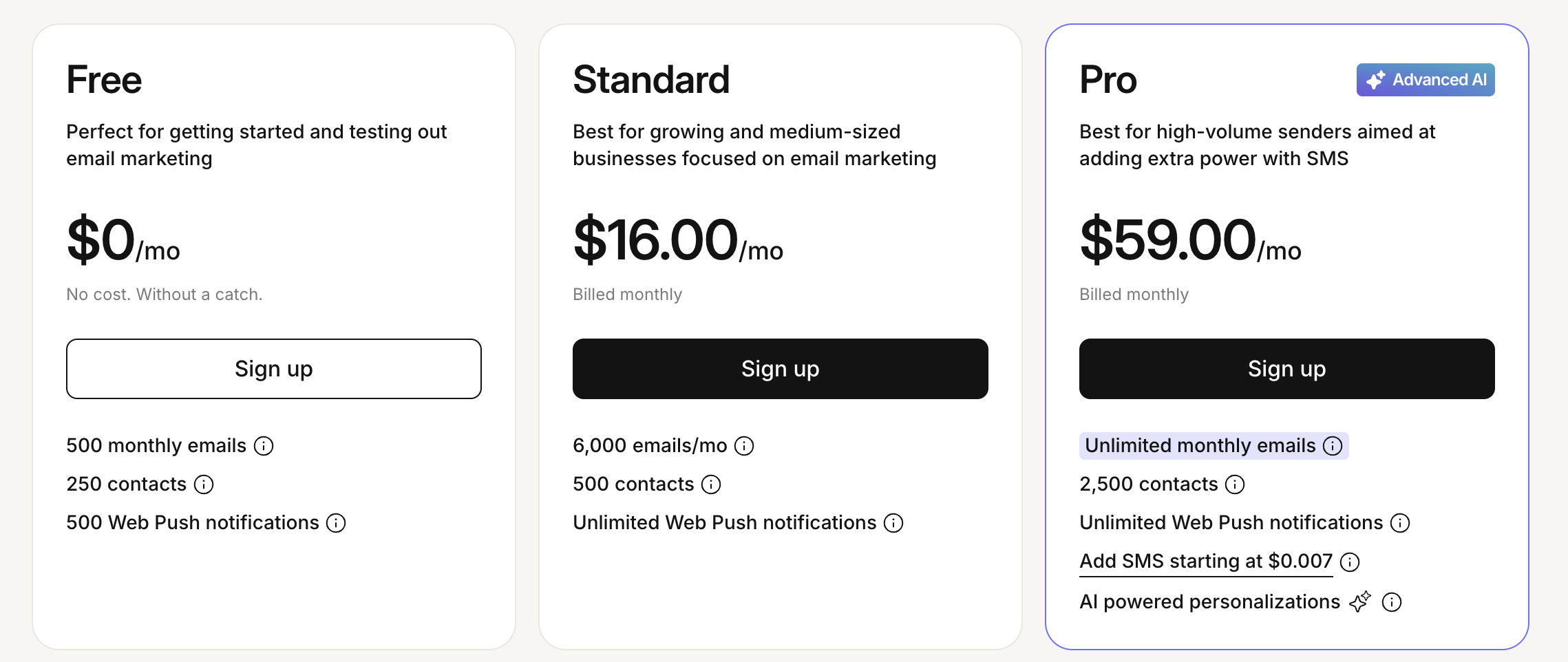
Omnisend bundles SMS as a paid add-on to its email marketing platform. There's a free tier for up to 250 contacts and 500 monthly emails.
To send SMS, you need the Pro plan at $59/month, which covers 2,500 contacts and unlimited emails.
SMS credits sit on top of that and use volume-based pricing:
- $0.009 per US SMS at the lowest tier ($10–$49.99/mo spend)
- $0.0085 per SMS at $50–$999.99/mo
- $0.008 per SMS at $1,000–$9,999.99/mo
- $0.007 per SMS at $10,000+ monthly spend
The platform is built around Shopify and other ecommerce stores. The main use cases are abandoned cart flows, product browse abandonment, and post-purchase sequences. There's no per-seat pricing, no native CRM integration for B2B tools, and no calling.
Best for: Shopify, BigCommerce, or WooCommerce stores using email-led marketing where SMS supports the same automation flows.
G2 rating: 4.6
Klaviyo
Klaviyo runs a credit-based SMS add-on on top of an email platform.
There's a free tier for up to 250 active profiles with 150 SMS credits included. The combined email and SMS plan starts at $35/month, which covers email plus 1,250 SMS credits each month. Costs scale based on contact count, message type, and message volume beyond the included credits.
Klaviyo's SMS coverage spans 20+ countries. The platform integrates deeply with Shopify and uses purchase behavior to trigger flows. It doesn't offer per-user pricing, calling, or native CRM integration with HubSpot or Salesforce.

Best for: DTC and ecommerce brands that already run email through Klaviyo and want SMS attached to the same flows.
G2 rating: 4.6
Mailchimp SMS

Mailchimp offers SMS as a paid add-on bundled with its email marketing plans.
SMS is not available on the Free plan, but it can be added to any paid tier. SMS pricing starts at $20/month on top of the email plan cost, and you're not charged for SMS until your application is approved.
Here are the combined starting prices:
- Essentials + SMS at $33/month
- Standard + SMS at $40/month
- Premium + SMS at $317.50/month
Each tier increases the email volume and SMS feature set. MMS marketing is only included on Standard and Premium tiers. Multi-country SMS and short codes require additional cost on any tier.
It works alongside Mailchimp email automations, but lacks the CRM-native workflows and shared inbox features that B2B sales teams rely on. G2 rating: 4.4

Best for: Small businesses already using Mailchimp for email who want to add basic SMS broadcasts without switching tools.
G2 rating: 4.4
SMS Marketing Pricing vs. Email Marketing
Per message, SMS is more expensive than email. A bulk email sent through Mailchimp or Klaviyo costs a fraction of a cent per recipient. An SMS through the same platform runs three to five cents per send, before carrier fees.
The cost-per-reach math is different.
According to our SMS Benchmark Report, SMS achieves a 98% open rate compared to email's 22%, and click-through rates are 45% on SMS with links versus around 5% on email.
Reply rates on outbound SMS are 11% within 24 hours, while most sales-team email reply rates are in the low single digits.
Here's what that looks like in practice for a B2B team:
On the email side, 5,000 sends are negligible cost on any paid email plan. Reply rates of 1–3% put you at 50 to 150 replies.
Email replies arrive over days, from a fraction of the contacts who opened the message.
On the SMS side, 5,000 messages costs around $179/month on Salesmsg. At the 11% benchmark reply rate, that's roughly 550 replies.
Cost-per-reply is around $0.33, and the replies arrive within hours from contacts who actually saw the message.
For broad newsletter content, email still wins on cost. For lead follow-up, demo confirmation, deal revival, and renewal check-ins, SMS wins on speed and answer rate. Most B2B teams use both, and route messages based on what the contact is actually likely to respond to.
How to Choose an SMS Marketing Platform on a Budget
These five questions will help you choose the right SMS marketing platform for your business.
How big is your team?
If one or two people are sending texts, most credit-based plans work fine and you won't hit extra-user fees.
If five or more reps need access, a bundled plan with cheap additional seats (like Salesmsg at $10/seat) is usually cheaper than a credit plan that charges $20/seat on top of the base.
What's your monthly volume?
- Under 500 messages/month: most starter plans work
- 500 to 5,000/month: mid-tier credit plans or bundled plans both fit
- Above 5,000/month: look at per-message rates carefully, because the gap between platforms gets wide
Do you need calling on the same platform?
If yes, Salesmsg includes calling on every plan from the same number, with no separate VoIP tool to add.
Most other platforms on this list don't include calling at all. Adding a separate VoIP tool runs $20 to $50 per user per month on top of the SMS bill.
What CRM are you on?
HubSpot, Salesforce, ActiveCampaign, and Pipedrive integrations are standard on B2B-focused platforms and absent from most ecommerce-focused ones.
If your reps use HubSpot, look at the best HubSpot SMS tools before committing to anything. If they're in Salesforce, check what Salesforce SMS options actually work inside workflows rather than as a third-party connector.
Have you accounted for 10DLC?
Add roughly $50 in registration fees and $10/month per campaign to whatever the platform is quoting.
Some platforms include this in onboarding. Others bill it separately.
Choosing the right platform
The cheapest plan is rarely the one that produces the best return. The one that fits your workflow is.
Our 2026 Benchmark Report shows 36% of Salesmsg customers trigger automated SMS from CRM workflows, and those teams see meaningfully higher engagement than teams only sending standalone broadcasts.
Cost matters, but matching the platform to how your team actually works matters more.
For broader context on platform selection, see our guide to the best SMS marketing software.
SMS Pricing Isn't What Most Teams Think It Is
The real cost in SMS comes from the line items that don't show up until the first invoice:
- Additional-user fees
- Carrier surcharges
- 10DLC registration
- Overages when a campaign runs long
For B2B teams, a bundled plan with calling, CRM integration, and 10DLC handled during onboarding usually costs less than a credit-based plan plus a separate VoIP tool. You're not just paying for messages. You're paying for a system that runs without anyone managing it manually.
Skip the spreadsheet gymnastics. Book a 15-minute demo and we'll walk through pricing for your team size, your CRM, and your volume.

Frequently Asked Questions
How much does SMS marketing cost per month?
Most B2B teams pay $25 to $500/month, depending on message volume and team size.
Entry-level plans on Salesmsg and SimpleTexting start at $25 to $39/month. Enterprise plans for high-volume senders run $1,000+/month.
What is the average cost per SMS message?
Standard US SMS runs $0.0083 to $0.05 per message, depending on whether you're on a raw API like Twilio or a fixed-plan platform. MMS messages cost three to five times more.
Bulk pricing tiers bring the per-message rate down at higher volumes.
What is 10DLC and does it add to my SMS marketing cost?
10DLC is the carrier registration US businesses need to send business SMS at scale.
A one-time brand fee runs $4 to $50, plus monthly campaign fees of $1.50 to $10. Most platforms handle 10DLC registration during onboarding, though the fees themselves are passed through to customers from the carriers and The Campaign Registry.
Skipping registration leads to message blocking, not just filtering.
How is bundled pricing different from credit-only pricing?
Credit-only pricing charges for message volume and bills everything else (seats, numbers, calling) as separate add-ons.
Bundled pricing rolls all of it into one base price. For small teams sending steady volume, bundled plans usually cost less.
Salesmsg starts at $25/month for 500 credits with one seat and one number included.
Is SMS marketing more expensive than email marketing?
Per message, yes. Per response, often no. SMS open rates average 98% versus 22% for email, and reply rates run far higher. For B2B sales teams using SMS for lead follow-up and deal revival, the cost-per-response usually beats email.
What does SMS marketing ROI look like for a sales team?
A team sending 5,000 messages/month on a $179/month Salesmsg plan can expect roughly 550 replies and 16 demos at benchmark rates. At an average deal size of $3,000, that's $48,000 in potential pipeline. The math gets stronger when texts run on CRM-triggered automation.
Does Salesmsg charge separately for SMS and calling?
No. Both run from the same number on the same plan, with no separate calling add-on or VoIP tool needed.
.png)