What Is a 6-Digit Code? 2FA Codes vs Short Codes (2026 Guide)



_What%20is%20a%20Six-Digit%20Short%20Code%20and%20How%20to%20Get%20One%20in%202026.webp)

A 6-digit code is one of two things. It's either a one-time verification code (the kind you get when you log into your bank), or a short code, a 5 or 6-digit phone number businesses use to send high-volume text messages.
This guide covers both.
If you have thousands of contacts you want to text for your business, you can apply for a six-digit short code number to send these text messages.
Once you have a six-digit code or six-digit phone number, you can use it to send:
- SMS broadcasts
- MMS broadcasts (texts with videos, images, PDFs.)
- Two-way text messages
- Alerts and notifications
- Automated texts through your CRM
- And more
Below, you'll learn everything you need to know about six-digit codes. We'll dive deep into texting with six-digit short codes, the benefits of using six-digit short codes, and how you can start using six-digit short codes throughout your business texting strategy.

2FA codes vs short codes: which one are you asking about?
Most people end up on this page for one of two reasons.
You received a 6-digit code in a text and want to know what it is. That's almost always a two-factor authentication (2FA) code. A service you're logging into, like your bank, email, or social account, sends a one-time code to your phone to confirm it's really you. The code expires in a few minutes. You're not signing up for anything by receiving it. Never share it with anyone who calls or texts you asking for it.
You're a business and want to send text messages at scale. That's a short code, a 5 or 6-digit phone number leased through the U.S. Short Code Registry. Companies use short codes to send marketing texts, alerts, order updates, and the 2FA codes mentioned above. Short codes can send up to 100 messages per second, which is why high-volume senders use them instead of 10-digit numbers.
The rest of this guide covers short codes for business. If you're trying to figure out a specific code you received, the U.S. Short Code Directory lets you look up who registered it.
Why SMS still beats email and other channels
SMS delivers the highest engagement of any digital channel businesses can use today.
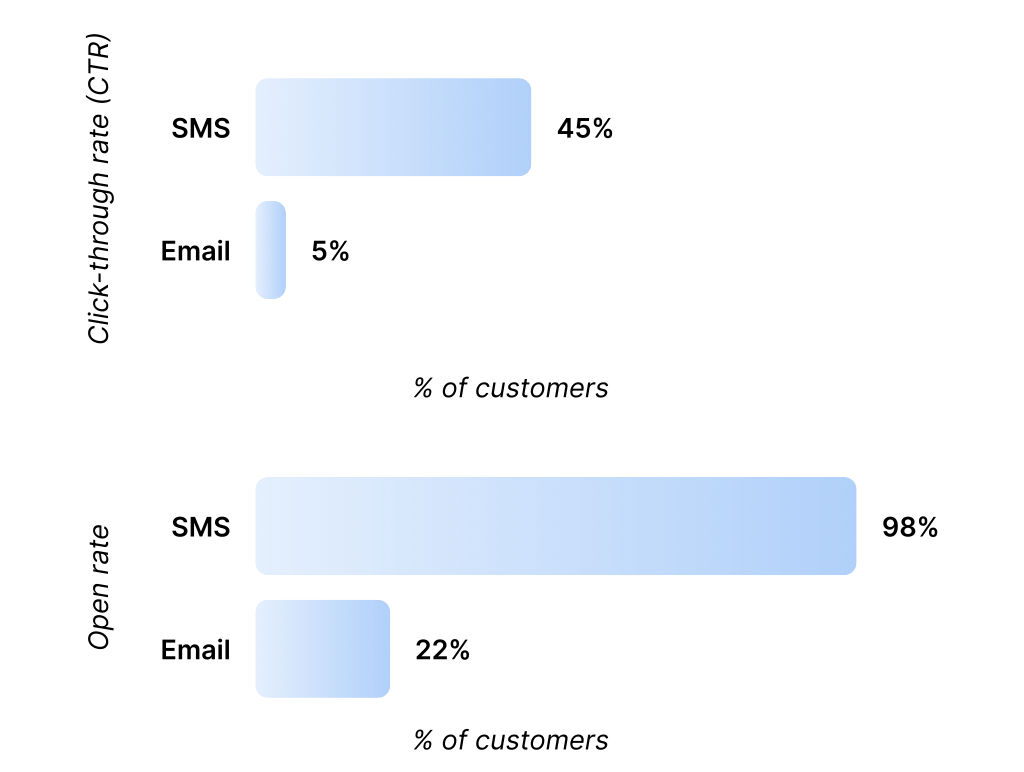
According to the 2026 State of SMS Benchmark Report:
• 98% open rate. 90% of texts are read within 3 minutes.
• 45% click-through rate on SMS with links, compared to under 5% for email.
• 11% reply rate on outbound SMS within 24 hours.
• 22% email open rate by comparison.
The reason is structural. People don't sort texts into folders the way they sort email. Messages don't compete with 121 other items in an inbox. And the 160-character limit forces businesses to write something short enough to actually read.
The same Benchmark Report found that adding calling to SMS produces 2.6x the engagement of SMS alone, and AI agents lift reply rates by 88%. That's the case for using a real platform instead of texting from a personal phone.
If you're a marketer, you need to stand out in the sea of a crowded inbox. The average person receives 121 emails per day. Trying to rise above that noise is like trying to find a friend on the other side of a Taylor Swift concert just by shouting their name.
Looking at the numbers of how would-be customers engage with text messages, it's no wonder why so many businesses choose to send SMS messages to connect with customers and market their products and services.
There are many ways to use texting to communicate with your leads and customers, but one of the best is using a six-digit code. This unique and powerful phone number lets you text at scale.
What is a Six-Digit Code (in the world of texting)?
A six-digit short code is a 5 or 6-digit phone number that businesses lease through the U.S. Short Code Registry to send high-volume SMS. Short codes are easier for customers to remember than a regular phone number and clear carrier filters with very little message blocking.
Common uses:
• Send promotional SMS or MMS broadcasts
• Deliver order confirmations and shipping alerts
• Send appointment reminders and renewal notices
• Run text-to-join opt-in campaigns from social, in-store signage, or events
• Trigger automated texts from your CRM (HubSpot, Salesforce, ActiveCampaign)
You can get very creative with how you use your SMS short code.
Let’s say you want to grow your SMS list. You can use a text-to-join keyword along with your six-digit short code to capture leads from anywhere.
For example, you can use a text-to-join keyword and six-digit short code to grow your SMS list on social media. You can add a call-to-action to your Instagram reels, LinkedIn carousels or YouTube videos that says: “Text the word ‘JOIN’ to my number ‘123456’ to join my list, and get a copy of all my viral social media posts.”
Short codes can also be useful for in-person businesses like retail or restaurants.
Let’s say you run an up-and-coming bistro. You could use a short code and text-to-join keyword to encourage customers to join your loyalty program. Perhaps you post a sign in your restaurant that says: “Text the word ‘loyalty" to 678910 to join our loyalty program and get 20% off your next dinner."
Two Types of Six-Digit Short Codes
You should know the two main types of six-digit codes or SMS short codes. Although they perform the same function, they differ in a few important ways.
1. Random Short Codes
First, we have random short codes. These are a random string of five or six-digit numbers. They're typically used because they're more affordable. When you apply for a short code, a random SMS short code will be assigned to you.
2. Vanity Short Codes
Vanity short codes are also five or six-digit numbers, but you can customize these short codes to match your brand. For example, Target uses the six-digit short code 827438 because these numbers spell out TARGET on a push-button phone.
Vanity numbers are much easier to remember. They can be used throughout your marketing campaigns, like text-to-join, in-person events, and more. However, with this added functionality, vanity short codes are more expensive.
Compliance and Best Practices
TCPA Compliance
The Telephone Consumer Protection Act (TCPA) requires businesses to obtain explicit permission from customers before sending marketing texts. Without it, you risk per-message fines and reputation damage. For short codes specifically, the carriers will also block your traffic, which means even your opted-in customers stop receiving messages.
Opt-Out Instructions
If your business is using a short code or six-digit phone number, you must give your leads and customers an easy way to opt-out from your SMS list.
The best practice is to include easy-to-follow opt-out instructions in every text message. (For example: "Reply STOP to quit.") This allows your customers or leads to stop receiving SMS and MMS messages if they choose. This helps your business maintain trust and compliance.
Penalties for Non-Compliance
Non-compliance with the TCPA can lead to serious consequences. Businesses may face fines, be blocked by major wireless carriers, or lose the ability to use their digit short codes for marketing campaigns. Staying compliant protects both businesses and their customers.
Why Use a Six-Digit Short Code
The benefits of using a six-digit code aren't limited to specific businesses or types of industries. Being creative with using six-digit short codes can help you improve your customer experience, connect deeper with your audience, and elevate how you communicate with your customers.
High Deliverability
Short codes have the highest deliverability out of every type of phone number you can use for SMS. This means a higher percentage of the messages you send will actually reach your audience.
Less Message Filtering
If you’d like to send text messages with a short code, you have to fill out a more in-depth application process with the mobile carriers than using other types of numbers to text (like a 10-digit number or local number.) Although you're doing more work up front, there's very little filtering by the carrier when sending your messages. This means your messages get through.
High Message Volume
Short codes allow you to send up to 100 text messages per second, with no limit on the number of messages you can send. This works great for companies with a large SMS list or businesses that don't want to run into limits when running SMS campaigns.
Better for Your Brand
Customers like short codes. These five or six-digit numbers can give your brand a higher perceived value, because people often see short codes as more trustworthy than your typical 10-digit or toll-free number. (Of course, 10-digit and toll-free numbers are just as trustworthy, but this is the perception.)
Easier for People to Remember
A short code only has five or six numbers, so it'll be easier for your target audience to remember and use. Over time, short codes will be associated with your brand, improving brand recognition.
Better Customer Engagement
You can use a short code to increase engagement with your potential customers. For example, you might send personalized reminders, custom coupons, and critical alerts and encourage two-way messaging. This versatility of messaging helps you get to know your customers better and determine their needs without relying on different communication channels.
Database Portability
You can continue using a dedicated short code even if you move to another SMS provider. This prevents confusion among your customers and minimizes marketing disruptions in your SMS.
Your target audience can continue using the same six-digit code even as you make the switch, resulting in a consistent brand image and customer satisfaction.
Best for National Brands
Technically speaking, almost any business can use a short code for their SMS marketing. However, we have found at Salesmsg that short codes work best for larger businesses that operate on a regional or national level.
Larger national and regional companies use short codes to send higher-volume SMS broadcasts to their many customers. They also benefit from the higher perceived value, trust and reputation of short codes. (If you only operate locally, you may want to check out a 10-digit long code or toll-free number instead.)
How to use a short code with HubSpot or Salesforce
A short code on its own is just a phone number. What turns it into a working channel is the workflow it sits in.
For most revenue teams, that workflow lives in HubSpot or Salesforce. Here's what a short code setup typically looks like inside those systems:
Trigger texts from CRM events. A lead fills out a form, books a demo, or moves to a new pipeline stage. Your CRM sends a templated text from your short code, automatically, without anyone copying a number into a personal phone.
Log every reply on the contact record. When a recipient texts back, the message lands on their record in HubSpot or Salesforce, visible to the rep, the manager, and anyone else with access. No conversation lives on a personal device.
Segment broadcasts by list or property. Send a short-code broadcast only to the customers who match a saved list, a deal stage, or any custom property in your CRM.
Hand replies to an AI agent or to a rep. High-volume short code sends produce high-volume replies. AI agents handle the qualification step (confirming intent, gathering details, booking the next step), then hand off the live ones to a person.
This is the part most short code guides skip, and it's the part that decides whether a short code drives revenue or just generates noise.
How Does a Six-Digit Code Work?

By now, you already know businesses use six-digit codes to send SMS and MMS broadcasts for marketing, notifications, and alerts like two-factor authentication.
You have to lease these codes from the U.S. Short Code Registry. Once approved, your business can use the short code to send and receive SMS and MMS messages.
/imGetting a short code for business use isn't free. There’s a one-time fee, plus a quarterly fee to continue using a short code. Also, you'll need to follow a variety of compliance regulations to ensure you can keep texting your customers with your short code.
One of the most important rules when using a six-digit code is asking customers their explicit permission before sending them any messages. Failure to comply can result in fines.
Since customers need to give their expressed permission, you can ask them to in a variety of ways. For example, if you’re using a text-to-join keyword, you can simply ask would-be leads to text a specific keyword to your six-digit short code. For instance, if your business sells clothes, you can ask them to send the keyword "CLOTHES" to your six-digit phone number to subscribe to your text messages and alerts.
To learn more about SMS compliance and deliverability, check out my post on getting your text messages delivered.
Shared vs. Dedicated Short Codes
Shared Short Codes
In the past, businesses used shared short codes, where multiple companies shared the same digit code to save costs. However, due to wireless carrier regulations and security concerns, shared codes are no longer recommended. There's a much better way: Dedicated short codes.
Dedicated Short Codes
With dedicated short codes, businesses can lease their own five or six-digit number, offering greater brand recognition and reliability. A dedicated vanity code further enhances customer engagement by making the number memorable, such as "Text 123456 to join."
How Can You Get a Six-Digit Number?
Ready to use your own short code with Salesmsg?
Securing a short code for your business requires several steps. You have to submit an application, make sure you’re in full compliance, before you can get approval to use a short code for texting. The processing time takes 8 to 12 weeks.
By using Salesmsg, we can help make the entire application process as painless as possible. (This is a service available for our premium clients.)
Here's an overview of the steps involved in getting your own six-digit short code:
Step 1. Decide on the Type of Short Code You Need
The first step in getting a short code is deciding if you want to use a random six-digit code or a dedicated vanity code.
After that, the short code is leased from the U.S. Short Code Administration. Note that you never own your short codes: They're leased quarterly.
This may be inconvenient, but it does allow for flexibility and the ability to change or add new short codes to your SMS campaigns.
If your budget allows, we recommend getting vanity short codes as they're easier to remember and makes your brand even more memorable. But if you don’t have a larger marketing budget, a random six-digit code is cheaper, making it a better option for small or new companies.
Step 2. Submit Your Application to The Carriers
After that, it's time to submit your application.
The short-code application process includes a brief questionnaire. Be prepared to answer questions about your business and how you intended to use the short code.
You’re also required to provide a visual mock-up that shows where potential customers will see your short code advertised. This can be a mockup of a website, signage or script. If you need help creating a visual mock-up, Salesmsg can walk you through it.
Once you’re ready to submit it, your application will go to the major carriers for their review and approval. Again, this happens because the carriers regulate short codes.
Step 3. Activate and Test Number
Once your application has been approved, the wireless carrier will activate your number.
Then, you can send your first test campaign to ensure everything is working properly.
Step 4. Start Sending Short Code Messages
Once your number is activated and working, you can start sending out short-code text message campaigns using our texting platform, Salesmsg.
With Salesmsg, you can create, send, manage, and automate your SMS campaigns. But, you also get access to in-depth SMS campaign data. This helps you refine your campaigns over time to help improve your conversions and deliver a better experience.
Everything to Know About Six-Digit Codes: Conclusion
Six-digit codes are indeed powerful for your marketing.
Not only do six-digit codes allow you to get creative with your marketing and SMS lead generation campaigns, but you can also send the highest volume of messages with the least amount of filtering. If your company and your customer base are growing, you'll want this channel to stay in touch, market more efficiently, and ultimately make more sales.
If you're looking for the easiest way to get started using a short code texting app, Salesmsg is your solution. We not only handle the short code texting approval process but also provide you with tips and best practices to maximize your SMS campaigns.
Want to talk to someone about short codes for your team?

Frequently Asked Questions
What is a 6-digit code on my phone?
A 6-digit code in a text is almost always a two-factor authentication (2FA) code. A service you're logging into sends it to confirm it's really you. The code expires in a few minutes and should never be shared with anyone who asks for it by phone or text. Some businesses also send 6-digit codes for things like delivery confirmations or password resets, but the security pattern is the same: the code came from a request you made.
What is my 6-digit code?
If a service is asking for your 6-digit code and you don't see it, check your recent SMS messages from the short code number that service uses. The code is sent to the mobile number on your account. If you didn't request a code, don't share it. Treat unexpected 6-digit code messages as a possible phishing attempt.
How is a six-digit short code different from a 10-digit phone number?
A six-digit short code is built for high-volume sending: up to 100 messages per second with very little carrier filtering, after a registration process that takes 8 to 12 weeks. A 10-digit phone number is built for two-way conversations and lower throughput, with a faster setup but higher message filtering. Use a short code for broadcasts and alerts. Use a 10-digit number for sales conversations and customer support.
What are the benefits of using a six-digit short code?
Higher deliverability, very little carrier filtering, up to 100 messages per second, easier for customers to remember, and database portability if you switch SMS providers. Vanity short codes add brand recognition because the number itself can spell a word (Target uses 827438 = TARGET).
What is the difference between random short codes and vanity short codes?
Random short codes are auto-assigned and cheaper. Vanity short codes are picked by you and cost more per quarter. Vanity codes are worth the premium when the number itself becomes part of your brand (signage, packaging, ads). Random codes are fine when the channel matters more than the digits.
How can businesses ensure compliance when using a six-digit short code?
Get explicit opt-in from every recipient before sending. Include opt-out instructions ("Reply STOP to quit") in messages. Keep records of when and how each contact opted in. Honor STOP requests immediately. For the full set of carrier rules, see the 10DLC blueprint.
How long does it take to get a short code?
8 to 12 weeks from application to active number. The wait covers carrier review of your use case, message samples, and opt-in process. Vanity short codes can take longer if your preferred number is already leased. Salesmsg handles the application paperwork for short code customers.