10 Best Ringless Voicemail Providers for 2026


_10%20Best%20Ringless%20Voicemail%20Providers%20for%202026.webp)

If you're comparing ringless voicemail providers, the real question isn't whether the channel works. It's which platform lets your team send campaigns cleanly, stay organized, and turn a voicemail drop into an actual conversation instead of a dead end.
The best tools here do more than deposit a message into voicemail. They connect that drop to your CRM, make the next step clear when a prospect calls or texts back, and keep your outreach defensible from a compliance standpoint.
Ringless voicemail has grown popular because it's cheap to run and doesn't interrupt anyone with a ring. Published performance numbers for the channel vary widely from vendor to vendor and are hard to verify independently, so treat any specific percentage you see quoted, including ours, as a starting point for your own testing rather than a guarantee.
What actually decides your results is provider selection: deliverability, compliance posture, and how well the tool fits your existing workflow matter more than a long feature list.
Below, we compare the 10 best ringless voicemail providers for 2026, including features, pricing models, strengths, and trade-offs, so you can choose the right platform for your team.
Best ringless voicemail providers for 2026
Here's the shortlist worth evaluating this year:
- Salesmsg, best for teams that want ringless voicemail inside a full sales communication workflow
- VoApps DirectDrop Voicemail, best for compliance-focused enterprise campaigns
- Stratics Networks Ringless Voicemail Drops, best for large-scale outreach with auditable delivery records
- slybroadcast by MobileSphere, best for simple self-serve campaigns
- Drop Cowboy, best for multi-channel voicemail and SMS outreach
- Call Loop, best for teams that want predictable credit-based budgeting
- VoiceLogic Ringless Voice Messaging Voicecasting, best for managed-service execution
- Ringless.com, best for dedicated voicemail-only campaigns
- VoiceDrop.ai, best for AI voice personalization and workflow automation
- ProspectBoss CRM Dialer with Ringless Messages, best for teams that want a bundled CRM, dialer, and voicemail stack
1. Salesmsg
Best for: Sales teams that want ringless voicemail, SMS, calling, and CRM activity in one place
Salesmsg is the strongest overall option for teams that don't want ringless voicemail living in a disconnected tool.
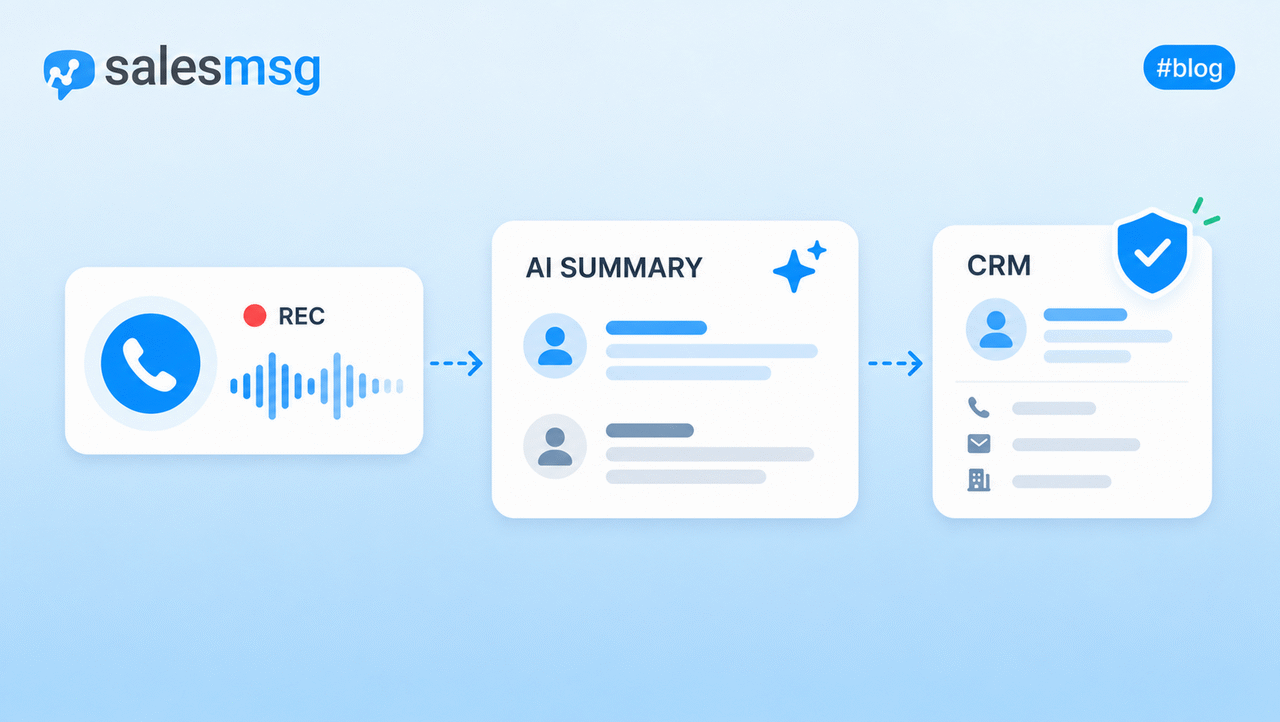
Instead of treating voicemail drops as a standalone feature, Salesmsg places them inside a broader outreach workflow that also includes two-way texting, calling, automation, AI agents, and CRM syncing. That matters because the real value of a voicemail campaign usually shows up after the drop, when a lead replies, calls back, or needs follow-up from a rep.
For most sales teams, the practical advantage is visibility. When voicemail activity, texts, calls, transcripts, and AI summaries all live on the same contact timeline, reps respond faster and managers get a clearer picture of pipeline activity.
Why Salesmsg stands out
The biggest strength is CRM-native execution. If your team already works in HubSpot or Salesforce, Salesmsg keeps outreach tied to the contact record instead of pushing reps into a separate voicemail dashboard.
Pairing a voicemail drop with a same-number follow-up text is where this shows up most. Businesses that run SMS alongside calling see a median engagement rate of 24%, compared with 9% for text alone, per our own 2026 State of SMS Benchmark Report. If a lead doesn't call back after the drop, your power dialer and text thread are already in the same place to follow up.
Salesmsg also brings a stronger compliance posture than many pure-play RVM tools, with SOC 2, TCPA and 10DLC support, and a HIPAA option for regulated industries.
Pros
- Native CRM sync with automatic activity logging
- Shared inbox, calling, SMS, and ringless voicemail in one platform
- AI agents and workflow automation handle follow-up and scheduling
- Enterprise-friendly compliance options, including SOC 2 and a HIPAA option
- Free trial available for testing
Cons
- Primarily focused on the U.S. and Canada
- Credit-based pricing takes some onboarding for new users
If you want one platform that handles both the voicemail drop and everything that should happen after it, Salesmsg is the best place to start.
2. VoApps DirectDrop Voicemail
Best for: Lending, collections, and enterprise teams that prioritize compliance and delivery mechanics
VoApps is one of the better-known providers in the ringless voicemail space, especially for organizations that care more about process and compliance than self-serve ease.
Its DirectDrop approach deposits messages into voicemail without a live ring, and the company clearly positions the product toward regulated, high-volume use cases like lending and collections.
Why VoApps stands out
VoApps emphasizes successful-delivery billing and compliance-oriented documentation, a different value proposition from SMB tools built for quick list uploads and simple broadcasting.
For enterprise teams, that's a strength. For smaller teams, it may feel heavier than necessary. The biggest drawback is pricing transparency: there's no public pricing page, so buyers need to go through sales to understand cost.
Pros
- Direct-to-voicemail delivery built for wireless numbers
- Pricing aligned to successful delivery
- Strong fit for structured enterprise campaigns
Cons
- No public pricing
- Better for programmatic or high-volume use than casual campaigns
VoApps is best for teams that already know their process and want a vendor built to support it.
3. Stratics Networks Ringless Voicemail Drops
Best for: High-volume outreach teams that need proof of delivery and campaign administration controls
Stratics Networks is built for scale. It's less about a sleek interface and more about operational rigor, which makes it a common choice for political organizations, nonprofits, and commercial teams running large coordinated campaigns.
Why Stratics stands out
A notable feature is auditable delivery logging. Stratics says it records each insertion for proof of delivery, useful when teams need internal reporting or campaign reconciliation. The platform also supports voice broadcasting and survey tools alongside ringless voicemail.
As with most tools in this tier, pricing is quote-based, and compliance remains the sender's responsibility. A provider can improve delivery operations, but it can't make a risky campaign compliant on its own.
Pros
- Auditable insertion logging
- Enterprise-scale campaign tools
- Voice broadcasting and survey capabilities included
Cons
- Quote-based pricing
- Compliance burden still sits with the sender
If your team needs operational proof and not just message delivery, Stratics deserves a close look.
4. slybroadcast by MobileSphere
Best for: SMBs, real estate teams, and users who want fast self-serve setup
slybroadcast is one of the easiest ringless voicemail platforms to launch. If your list is ready and your audio is recorded, you can typically get a campaign out quickly without much implementation work.
Why slybroadcast stands out
The platform offers pay-as-you-go credits that don't expire, plus monthly subscriptions. It supports recording or uploading audio, scheduling, CSV uploads, mobile uploads, and international options, which covers the basics well for teams running occasional campaigns.
At higher volume, the convenience can become more expensive than infrastructure-heavier options built for scale.
Pros
- Fast self-serve onboarding
- Flexible credit model with no expiration
- Good fit for occasional campaign use
Cons
- Can get expensive at scale
- Fewer advanced controls than enterprise tools
If you want a platform you can learn quickly without much technical help, slybroadcast is a strong option.
5. Drop Cowboy
Best for: Sales and marketing teams that want voicemail and SMS coordination in one tool
Drop Cowboy treats ringless voicemail as part of a broader outreach sequence, combining voicemail, SMS, scheduling, and automation from a single dashboard.
Why Drop Cowboy stands out
The platform promotes AI voice cloning through Mimic AI, aimed at making messages sound more personal. That's useful for appointment reminders, simple sales sequences, and campaigns where the voicemail is only the first touch, not the whole strategy.
Pros
- Ringless voicemail and SMS in one dashboard
- AI voice cloning for more personalized messaging
- Good fit for coordinated campaign follow-up
Cons
- Pricing often requires a sales conversation or account access
- Consent management still matters on U.S. campaigns
Drop Cowboy makes the most sense when voicemail is part of a sequence, not the full strategy.
6. Call Loop
Best for: Teams that want one credit model across SMS, voice broadcast, and ringless voicemail
Call Loop is a practical choice for organizations that care about budgeting clarity. Its strongest advantage is a unified credit system across channels, which simplifies forecasting for teams running mixed outreach campaigns.
Why Call Loop stands out
The single-balance model is easy to understand, especially useful when one campaign mixes ringless voicemail with SMS or voice broadcasting. The trade-off is that per-message credit usage can get expensive at larger scale, and the platform doesn't appear as compliance-focused as some enterprise-first providers.
Pros
- Unified credit system across channels
- Clear public documentation
- Good fit for mixed-channel campaigns
Cons
- Costs can rise at high volume
- Less compliance depth than enterprise-oriented tools
If cost predictability matters more than advanced specialization, Call Loop is worth considering.
7. VoiceLogic Ringless Voice Messaging Voicecasting
Best for: Teams that want vendor-managed campaign support instead of a purely self-serve tool
VoiceLogic leans into managed execution rather than pure software, attractive for smaller teams, irregular campaigns, or organizations that don't want to run every operational detail internally.
Why VoiceLogic stands out
The biggest benefit is reduced operational lift. A more hands-on vendor can help teams launch campaigns without building a full internal process, useful in fundraising, political outreach, and other high-volume environments.
Pricing is quote-based, and compliance still requires close attention. Consent management is central to risk control in this category, regardless of vendor.
Pros
- Hands-on campaign support
- Lower burden for non-technical teams
- Familiarity with high-volume outreach use cases
Cons
- No public pricing
- Compliance review is still essential
VoiceLogic makes sense when your team wants a service partner, not just software.
8. Ringless.com
Best for: Agencies, resellers, and teams that want a dedicated voicemail-only platform
Ringless.com stays focused on one job. That narrow positioning is a benefit for buyers who only want to run voicemail campaigns, and the platform supports white-label options that appeal to agencies packaging outreach for clients.
Why Ringless.com stands out
The value here is simplicity and speed. Quick onboarding and campaign scheduling make it easy to get started without extra channels or a larger communication workflow to manage. The main limitation is that public technical detail is fairly limited, and there's no native SMS or email layer to support follow-up.
Pros
- Purpose-built for ringless voicemail
- White-label options available
- Minimal learning curve
Cons
- Limited public technical detail
- No native SMS or email support
Ringless.com is a sensible choice when voicemail is the only channel you need.
9. VoiceDrop.ai
Best for: Teams that want AI voice personalization and automation-friendly workflows
VoiceDrop.ai leans heavily into AI-driven personalization, a reasonable bet for teams that believe callback quality improves when messages sound more human and specific.
Why VoiceDrop.ai stands out
Voice cloning, dynamic personalization, API access, and Zapier support make this platform attractive for workflow-heavy teams. If your voicemail content changes by lead source, stage, or trigger, those automation hooks are useful. As with any newer entrant, test deliverability and operational fit carefully before a broader rollout.
Pros
- Personalized voice at scale
- API and Zapier access
- Rollover on unused units
Cons
- Newer than legacy vendors
- Deliverability should be tested before scaling
If your biggest challenge is avoiding robotic-sounding outreach, VoiceDrop.ai is worth exploring.
10. ProspectBoss CRM Dialer with Ringless Messages
Best for: Real estate, insurance, and home services teams that want an all-in-one outbound stack
ProspectBoss combines CRM, dialer, email, SMS, and ringless voicemail into one bundled environment, attractive for industry-specific sales teams that would rather consolidate tools than manage separate vendors.
Why ProspectBoss stands out
ProspectBoss supports mixed cadences across email, text, and voicemail, valuable for smaller teams that need breadth more than deep specialization. Ringless voicemail specifics show up more often in blogs and help materials than in a deep technical product page, so validate delivery and compliance details during testing.
Pros
- All-in-one CRM, dialer, and ringless voicemail workflow
- Email, SMS, and voicemail campaign support
- Simplifies tool consolidation for industry-specific outbound teams
Cons
- Ringless voicemail details need validation during trial
- Less specialized than pure-play providers
ProspectBoss is a practical option for teams that value consolidation over specialization.
Feature and pricing comparison
How to choose the best ringless voicemail provider
The right platform depends on how you plan to use it. Here's what to evaluate before you buy.
Deliverability
Can the provider reliably place messages where recipients will actually hear them? Delivery rates vary by list quality, carrier, and campaign setup, so ask any vendor for their own data and test with a small batch before committing to volume.
Compliance posture
No vendor removes responsibility from the sender. If you're contacting wireless numbers in the U.S., your team needs to understand TCPA obligations and confirm how the platform supports your compliance process. Our SMS marketing compliance guide covers the same consent and registration principles that apply here.
CRM and workflow fit
A voicemail drop should create a next step. If replies, callbacks, and campaign history live in different systems, follow-up slows down. Platforms that keep messaging, calling, and contact records together are easier for sales teams to use consistently.
Pricing model
Some vendors use credits, some use subscriptions, some use quote-based enterprise pricing. The right model depends on whether your usage is occasional, high-volume, or spread across multiple channels.
Support and setup
Some teams want a fast self-serve launch. Others want onboarding help or managed execution before rollout. The right choice depends on your internal resources.
FAQ
What is ringless voicemail?
Ringless voicemail deposits a pre-recorded message directly into a recipient's voicemail box without the phone ringing. It's used for reminders, follow-ups, and outreach campaigns where a call would be too disruptive.
Is ringless voicemail legal?
It can be, but consent requirements under the TCPA still apply to wireless numbers. Legal risk depends on how you obtain consent and how the provider handles opt-outs, not on the channel itself.
What's the difference between ringless voicemail and a power dialer?
Ringless voicemail deposits a one-way message with no live call. A power dialer connects a real rep to a live call when someone answers. Many teams use both together: a dialer for live conversations, ringless voicemail for the calls that go unanswered.
Can ringless voicemail work alongside AI agents?
Yes. When a voicemail drop leads to a text reply or callback, AI SMS agents can qualify the lead or book a meeting without a rep manually picking up every reply.
Which ringless voicemail provider is best for sales teams?
Salesmsg is the strongest fit for sales teams specifically, since ringless voicemail sits inside the same platform as two-way texting, calling, and CRM logging, rather than a standalone tool disconnected from the rest of the workflow.
Final verdict
The best ringless voicemail providers do more than deliver a message quietly. They help your team run outreach that's trackable, defensible, and easy to follow up on.
For most sales teams, Salesmsg is the strongest starting point because it combines ringless voicemail, SMS, calling, automation, and CRM visibility in one platform. For enterprise compliance needs, VoApps and Stratics may fit better. For self-serve simplicity, slybroadcast remains practical. For AI personalization or bundled workflows, VoiceDrop.ai and ProspectBoss bring different strengths.
The right choice comes down to your volume, your workflow, and how much visibility your team needs after the message is sent.
If you want to test ringless voicemail inside a real sales communication workflow, start a free trial of Salesmsg or book a demo to see it working alongside calling and CRM logging in one place.