9 Best Heymarket Alternatives for Revenue Teams in 2026



Heymarket works fine right up until a lead texts back with a question and your rep needs that reply logged, threaded, and ready for follow-up inside HubSpot or Salesforce. That's where the gaps show up: no native calling, a message storage cap in HubSpot, and pricing that climbs fast once you need automation or Salesforce.
This guide compares 9 Heymarket alternatives across pricing, CRM fit, and calling, built from an audit of Heymarket's own pricing page and each competitor's current plans, not recycled numbers from a directory site.
Why look for alternatives to Heymarket?
Heymarket runs into trouble the moment a lead texts back with a question or an objection and a rep needs that reply logged, threaded, and ready for follow-up. Four gaps show up consistently in user reviews and product comparisons:
- No native calling: Heymarket is a messaging platform covering SMS, WhatsApp, Facebook Messenger, Instagram, and Apple Messages for Business. A team that also calls leads runs a second tool for voice, then pieces two records together into one history.
- HubSpot integration hits a ceiling: Heymarket's HubSpot integration caps message object storage at 9,000 records per portal, then auto-erases past that every three hours. For a team running any real volume, that's a wall that shows up fast.
- Automation and analytics sit behind higher tiers: Campaigns, automations, and advanced reporting are locked to the Plus and Pro plans, not included on Standard.
- Pricing climbs by tier: Heymarket's own pricing page lists Standard at $49 per user per month, Plus at $99, and Pro at $199, all billed annually with a 2-user minimum. Salesforce is a separate add-on at $7.50 per user per month, and only available on Pro or Enterprise, not Plus. The jump from entry pricing to a Salesforce-ready plan is steep.
Nine platforms solve for those gaps in different ways. Here's how they compare.
The 9 best Heymarket alternatives
1. Salesmsg
Salesmsg is a conversation platform for revenue teams that unifies business texting, business calling, AI agents, and CRM-logged conversations in one place. A manager sees the full conversation without opening a second tool. Salesmsg recently added the ability to handle multiple incoming calls at once, so no caller gets dropped during a busy stretch, something Heymarket can't offer since it doesn't place or receive calls at all.
.webp)
What users say (G2 + Reddit): Salesmsg holds 4.7 out of 5 on G2 across 379 reviews. Reviewers repeatedly praise the HubSpot and Salesforce integrations, call transcription and summary notes, message templates that speed up client communication, and quick setup. The recurring gripes: credit-based pricing takes time to get used to at higher volume, and 10DLC approval takes a few weeks (an SMS-industry constraint, not a Salesmsg one), with reviewers wishing for more upfront timeline transparency before signing up.
Pros:
- Native two-way sync with HubSpot and Salesforce, no record cap or auto-erase
- Texting and calling from the same number, including simultaneous inbound call handling
- AI agents qualify leads and book meetings offline, with tracking for enrolled, in-progress, and completed contacts
- TCPA, 10DLC, and HIPAA compliance built in, with self-serve 10DLC upgrades
Cons:
- Built for teams already running a CRM
- Credit-based pricing takes getting used to at higher volume
Best for: Revenue teams at CRM-mature companies running texting, calling, and automation inside HubSpot or Salesforce.
Pricing: Plans start at $25/month. See full pricing.
2. TextUs
TextUs is built for sales and recruiting teams running high-volume outbound texting. It integrates natively with HubSpot, Salesforce, and staffing tools like Bullhorn and Greenhouse.

What users say (G2 + Reddit): TextUs holds 4.7 out of 5 on G2 across 629 reviews, with especially strong marks for usability and ease of setup. Reviewers highlight friendly, fast support and how well the daily call-list workflow fits recruiting and staffing teams. Where reviewers push back: the 140-character cap on text blasts (personalization tokens eat 20+ of those), delays when sending too many blasts at once, and price hikes at renewal that pushed some smaller teams to cheaper tools.
Pros:
- Native CRM and applicant-tracking integrations
- Bulk texting built around a rep's daily call list
- Strong fit for staffing, recruiting, and compliance-heavy outbound
- Fast, guided onboarding
Cons:
- Texting-first, calling is a lighter feature
- Mass-texting large groups gets clunky at scale
- Pricing isn't fully published and third-party estimates vary widely
Best for: Outbound sales and recruiting teams that live in a CRM and need fast, high-volume texting.
Pricing: Reported between $299 and $499/month for a base subscription, with per-seat and per-tier costs on top. TextUs does not publish full pricing, so confirm directly with their team before budgeting.
3. Textline
Textline is a shared-inbox texting platform built around HIPAA compliance and patented consent workflows, aimed at regulated industries rather than active sales pipelines.

What users say (G2 + Reddit): Textline holds 4.7 out of 5 on G2 across 377 reviews. Reviewers consistently call out how easy it is to train staff, the reliability of message delivery, and how transparent Textline is with medical offices about HIPAA setup and total cost. The frustrations that surface most often: no phone line for support (chat only), a single-login-per-username limit that kicks users out when they sign in elsewhere, a confusing billing setup when buying extra credits, and a UI that some describe as dated.
Pros:
- Patented consent workflows and HIPAA-ready compliance stack
- Unified inbox across SMS, MMS, and social channels
- Strong fit for regulated industries: healthcare, legal, financial services
- Signed BAA and detailed audit trail available
Cons:
- No native calling, voice stays with a separate provider
- Charges for inbound messages, not just outbound
- Per-agent pricing with a 3-agent minimum raises the entry price fast
Best for: Compliance-heavy teams in healthcare, legal, and financial services that need an audit-ready shared inbox and don't need calling.
Pricing: Essentials starts around $149/month (3 agents, 600 message credits). Pro runs around $349/month (5 agents, 2,000 credits). Enterprise is custom.
4. Podium
Podium centers on local business communication. Reviews, payments, and messaging live in one inbox, built for single- and multi-location businesses.
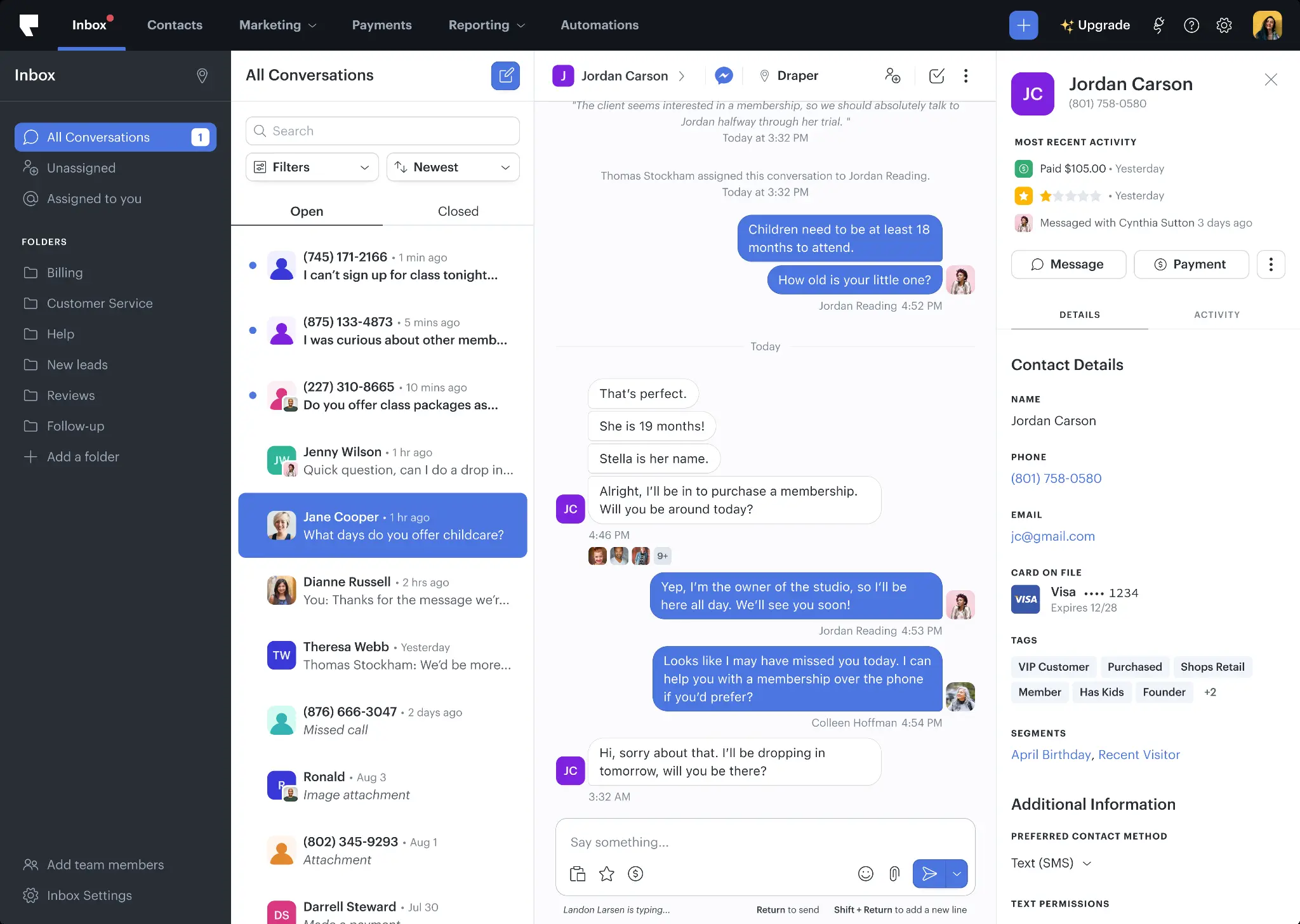
What users say (G2 + Reddit): Podium holds 4.6 out of 5 on G2 across roughly 2,066 reviews, with strong marks for its AI "Jerry" employee, review generation, and one-inbox setup. Off G2, the picture flips. The BBB has logged 62 complaints in three years (20 in the last 12 months), and Trustpilot, Capterra, and Reddit surface the same four themes: hard-to-cancel annual contracts with 30-day notice requirements, sticker shock at $459 to $689/month for the Core and Pro plans, slow or scripted support after signup, and a glitchy Android app.
Pros:
- Built-in review collection tied to Google Business and payment links
- Centralizes SMS, webchat, and social messaging in one inbox
- Strong fit for appointment-based local businesses
- AI tools respond to leads and automate parts of the conversation
Cons:
- Pricing isn't published. Entry plans are commonly reported around $399 to $599/month, and 3-5 location invoices often land $1,000 to $2,200/month with add-ons
- Built more for review and payment workflows than deep sales texting
- Contracts are annual and harder to exit than they look at signup
Best for: Local or multi-location businesses that want reviews, payments, and customer messaging bundled with texting.
Pricing: Not publicly published, quote-based. Commonly reported starting around $399/month for a single location.
5. SimpleTexting
SimpleTexting is a straightforward SMS marketing and two-way texting platform priced by message volume, with transparent published tiers and no sales call required to see pricing.
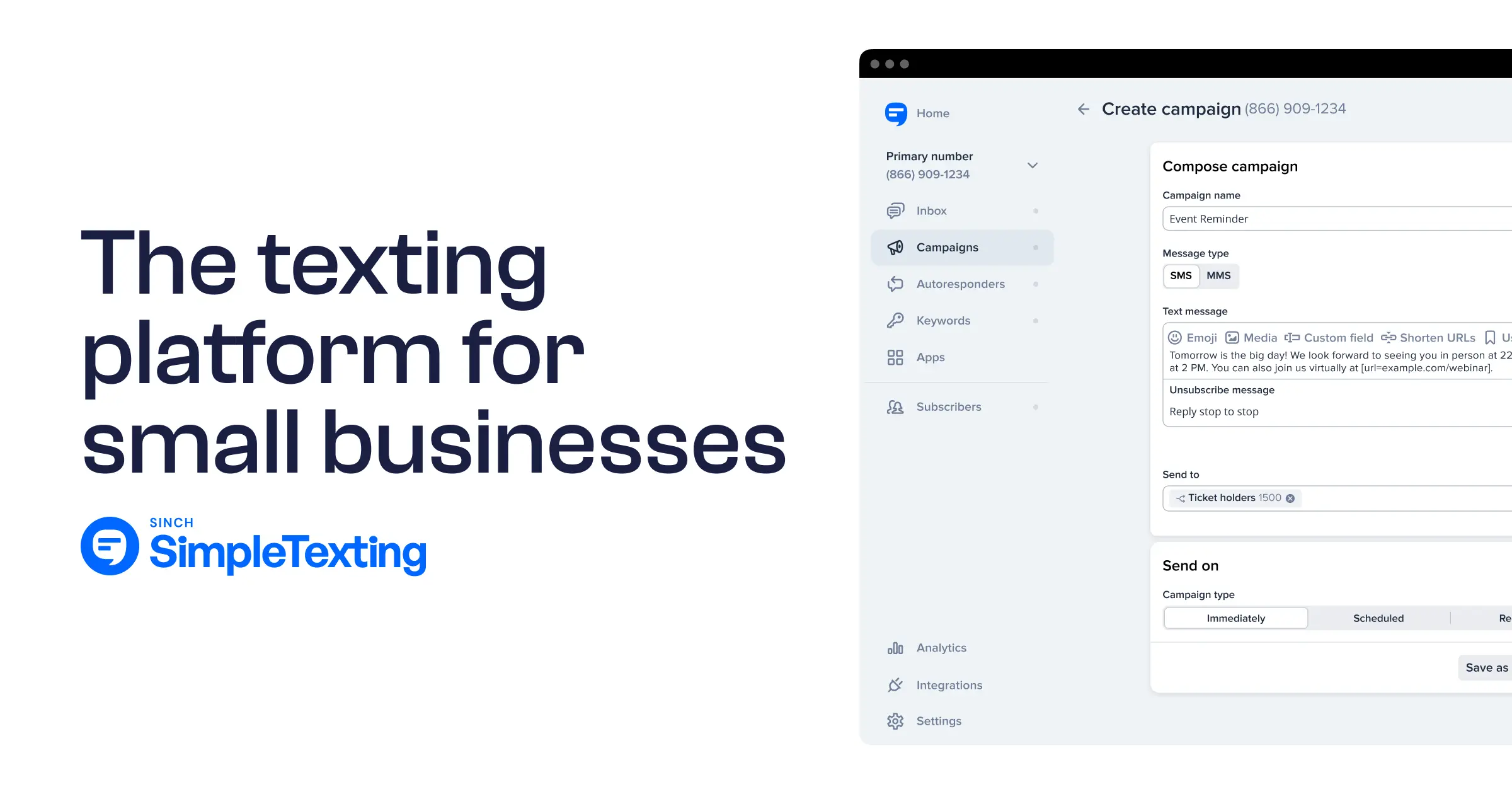
What users say (G2 + Reddit): SimpleTexting holds 4.7 out of 5 on G2 across 642 reviews. Reviewers highlight the intuitive interface, quick onboarding, fast live-chat support, and features like keywords and auto-responders that don't take a specialist to set up. The consistent pushback across G2 and Reddit: costs climb faster than expected as contact lists grow, overage charges hit without clear warnings, message delays crop up during heavy sends, and advanced automation is thinner than dedicated revenue-team platforms.
Pros:
- Published, transparent pricing across every tier
- Three user seats included on every plan
- Rollover credits reduce waste in slow months
- Full feature set, including automation and API access, available at every tier rather than gated behind higher plans
Cons:
- No native calling
- Additional users cost $20/month each beyond the included three
- CRM integrations are lighter than a dedicated revenue-team platform
Best for: Small businesses running SMS marketing and appointment reminders that want predictable, published pricing and don't need calling.
Pricing: Starts at $39/month for 500 credits (local number) or $29/month for a toll-free number, scaling to $909/month at 50,000 credits. Custom pricing above that.
6. Quo (formerly OpenPhone)
Quo, the rebranded OpenPhone, is a lightweight business phone system for small teams. It bundles a shared line, calling, and texting without much setup.

What users say (G2 + Reddit): Quo holds 4.7 out of 5 on G2 across roughly 3,295 reviews, one of the higher review counts in this category. Reviewers praise the clean, message-app-style interface, fast local-number setup for distributed teams, AI call summaries, and the HubSpot integration on the Business tier. The complaints that show up most on Trustpilot and Reddit: slow support during outages, unexpected account flags that block sending, occasional call drops on weak connections, and the fact that CRM sync and call transfers require the Business tier, not Starter.
Pros:
- Cheapest entry point among calling-capable alternatives on this list
- Shared numbers let a whole team handle calls and texts from one line
- Clean, message-app-style interface with a short learning curve
- HubSpot and Salesforce integrations available on the Business plan
Cons:
- CRM sync, call transfers, and analytics require the Business tier, not Starter
- Extra phone numbers and A2P registration fees stack on top of the base price
- Fair Use Policy prohibits cold calling and auto-dialers, a real limit for active outbound sales
Best for: Small teams or startups that need basic shared-line calling and texting without deep CRM or compliance requirements.
Pricing: Starts at $15/user/month annual for Starter ($19 monthly); Business runs $23/user/month annual ($33 monthly); Scale runs $35/user/month annual.
7. EZ Texting
EZ Texting is a credit-based SMS marketing platform built for campaigns and keyword-based list growth, with most advanced features included standard rather than gated behind higher tiers.
What users say (G2 + Reddit): EZ Texting holds 4.5 out of 5 on G2 across 730 reviews, with strong marks for ease of setup, Workflows, and A/B testing. Trustpilot tells a different story with a 3.3 score, and Reddit threads echo it: billing disputes, refund denials, and credits that expire (12 months on annual, 60 days on monthly) come up repeatedly. The pattern reviewers describe: the interface is genuinely easy, the invoice math is not.
Pros:
- Entry price starts at $25/month, one of the lowest in this category
- Unlimited incoming messages, contacts, and keywords on every plan
- Inbound messages are free, unlike several competitors on this list
- AI Compose and AI Reply included
Cons:
- No native calling
- Additional users cost $10/month each
- Credits expire (12 months annual, 60 days monthly), which can waste unused spend
- MMS messages cost 3 credits each, tripling the cost of image-heavy campaigns
Best for: Small businesses running high-volume SMS marketing and keyword campaigns on a tight budget who don't need calling.
Pricing: Starts at $25/month (Launch plan), scaling through Boost and Scale tiers up to roughly $3,000/month for Enterprise.
8. Birdeye
Birdeye bundles reputation management, review generation, and messaging into one platform, aimed more at multi-location local businesses than sales-led revenue teams.

What users say (G2 + Reddit): Birdeye holds 4.7 out of 5 on G2 across roughly 4,190 reviews, one of the largest review pools in this category. Reviewers highlight the AI review-response tools, integrations with practice management systems, and how well it handles multi-location rollouts. Off G2, the tone shifts. Trustpilot and Reddit threads focus on three recurring complaints: no transparent pricing (quote-only, and the number moves), post-signup cost increases including an annual "Innovation Fee" of roughly 8%, and difficulty cancelling once the contract is signed.
Pros:
- Strong review generation and reputation management tightly integrated with messaging
- AI Receptionist and AI reply tools included on most plans
- Handles multi-location businesses well, with volume discounts at scale
- Wide integration library covering CRM, POS, and practice management systems
Cons:
- No transparent public pricing, quote-based only
- Reports of steep post-signup cost increases, including an annual "Innovation Fee" of roughly 8 percent
- Built more for reviews and reputation than sales pipeline texting
Best for: Multi-location local businesses in healthcare, home services, or retail that want reviews, reputation management, and messaging bundled into one platform.
Pricing: Reported at roughly $299 to $449 per month per location, depending on tier and billing frequency. Multi-location and enterprise pricing is custom.
9. MessageDesk
MessageDesk text-enables an existing business phone number instead of replacing it. Calls stay with the current provider, RingCentral, Zoom, Dialpad, or a carrier, while texting routes into a shared MessageDesk inbox.

What users say (G2 + Reddit): MessageDesk holds 4.7 out of 5 on G2 across a smaller pool of 35 reviews. Reviewers repeatedly call out the ability to text-enable an existing business number without changing carriers, the shared inbox for team collaboration, and helpful sales and onboarding support. The trade-offs reviewers name: broadcasts cap at 100 contacts per send, the interface is built for line management rather than deep CRM-triggered automation, and pricing isn't published anywhere public (reported around $49/user/month as a starting point).
Pros:
- Connects up to 48 phone lines in one workspace
- Role-based permissions and custom views per team or department
- No need to disrupt an existing voice setup to add texting
- Built for dispatch, staffing, HR, and multi-location teams managing several lines at once
Cons:
- No native calling, voice stays with whatever provider the team already uses
- Built more for line management than deep CRM-triggered automation
- Broadcasts cap at 100 contacts per send, and mass texting requires a Pro-tier seat
Best for: Multi-line or multi-department teams, dispatch, staffing, HR, that need shared SMS across several existing phone numbers.
Pricing: Custom, based on lines and users. No public pricing page.
How to choose the right Heymarket alternative
Every platform here handles texting. Some stop there, split calling off into a separate tool, or lock CRM sync behind a higher tier. A few factors decide which gap matters most for your team:
- Calling, native or separate: Salesmsg and Quo text and call from one number. TextUs, Textline, Podium, SimpleTexting, EZ Texting, Birdeye, and MessageDesk all lean on texting first, with calling weaker, missing, or handled by a separate provider.
- CRM sync depth: Salesmsg and TextUs offer native, automatic sync with no record caps. Quo gates sync to its Business tier. The rest are less built around CRM-triggered workflows.
- Pricing model: Salesmsg and TextUs scale around message volume, fitting teams sending thousands of workflow-triggered texts a month. Podium, Quo, and Birdeye price per user or location, which gets expensive as headcount or location count grows.
- Line and location structure: MessageDesk is built for teams managing several phone lines and departments at once. Podium and Birdeye fit single- or multi-location businesses focused on reviews and payments.
- Compliance requirements: TCPA, 10DLC, and HIPAA handling varies across these platforms. Textline and Salesmsg both lead on compliance depth. Confirm what's built in versus what requires an add-on before signing.
These nine tools fall into two groups. Most handle texting well and treat calling or CRM depth as an afterthought. Salesmsg builds the full conversation, texting, calling, and CRM sync, as the product itself:
- Pricing that scales with message volume
- AI agents that track leads through enrollment, follow-up, and booking
- Simultaneous inbound call handling, so no caller gets dropped
- Self-serve 10DLC upgrades, no waiting on support
Book a demo to see how Salesmsg handles texting, calling, and CRM logging in one platform.
FAQ
Does Heymarket support calling?
No. Heymarket handles SMS, WhatsApp, Facebook Messenger, and similar channels. A team that calls leads needs a separate tool for voice.
How does Salesmsg's HubSpot sync avoid Heymarket's record cap?
Heymarket caps HubSpot message storage at 9,000 records per portal, auto-erasing past that every three hours. Salesmsg's native HubSpot and Salesforce sync logs every text and call automatically, with no ceiling to manage around.
Why does Heymarket look cheaper than Salesmsg at first glance?
Heymarket's Standard plan starts at $49 per user per month, close to Salesmsg's $25 starting price, but Heymarket's cost climbs fast by tier: Plus runs $99/user/month, Pro runs $199/user/month, and Salesforce is a separate $7.50/user/month add-on available only on Pro or Enterprise. Salesmsg scales with message volume instead, so cost tracks what a team actually sends.
Is Heymarket HIPAA compliant?
Only on the Pro and Enterprise tiers. Standard and Plus don't include HIPAA enablement, which is one reason healthcare teams often look at Textline instead, since HIPAA support is available across more of its plans.
What is the cheapest Heymarket alternative with calling?
Quo (formerly OpenPhone) starts at $15 per user per month for calling and texting, though its Fair Use Policy blocks cold calling and auto-dialers, so it fits small teams better than active outbound sales.
Can I keep my number if I switch from Heymarket?
Yes, in most cases. Salesmsg, TextUs, Textline, SimpleTexting, Quo, and EZ Texting all support number porting at onboarding. The bigger lift is usually rebuilding workflows in the new platform.
Is Heymarket good for sales teams, or built more for general business messaging?
Heymarket handles shared-inbox texting well, but a sales pipeline needs more. Teams running an active pipeline through HubSpot or Salesforce want calling, automation, and CRM logging in the same platform.
Which Heymarket alternative is best for a small team on a budget?
Quo or EZ Texting both start under $30 per user or per month, though Salesmsg's pricing scales down reasonably for small teams that also need calling and CRM sync.
What should I check before choosing a Heymarket alternative?
Whether the platform logs texts and calls to your CRM automatically, whether calling is built in or a separate tool, whether pricing scales with volume or per-user tiers, and who handles compliance, the platform or your team.
The bottom line
Heymarket is a capable shared inbox, but it stops at messaging. The moment a team needs calling, deeper CRM automation, or Salesforce without an add-on fee, one of these nine alternatives fits better. For revenue teams running an active pipeline through HubSpot or Salesforce, Salesmsg is the one built to do all three at once.
Book a demo or start a free trial to see how Salesmsg compares on your own workflows.