Health Care SMS Guide for Patient Engagement and Compliance



_Health%20Care%20SMS%20Guide%20for%20Patient%20Engagement%20and%20Compliance.webp)

The clinic phone starts ringing before the front desk has finished the morning check-in. A scheduler is leaving voicemail after voicemail, a nurse is resending paper reminders, and the appointment board still has empty slots from yesterday's no-shows. That's the everyday pressure behind health care SMS, because texting gives clinics a faster way to reach patients who have already missed calls, ignored email, or forgotten portal messages.
For many teams, the challenge isn't sending messages. It's sending the right message, to the right person, with the right level of detail, without creating privacy or compliance problems. Clinics that treat texting like a simple broadcast tool usually run into those issues first. Clinics that treat it like a workflow, part communication, part behavior design, usually get much better results.
Why Health Care SMS Matters Today
Health care SMS solves a basic operations problem. Patients still miss calls, overlook emails, and delay action when a reminder sits in a crowded inbox. A text message reduces that friction because it appears on a device people check often, and it asks for one clear action instead of forcing staff and patients through a longer back-and-forth.
That matters for clinic flow. Every missed reminder can mean an empty slot, a late arrival, or extra follow-up work for the front desk. SMS helps turn those scattered touchpoints into a short message that is easier to see, easier to confirm, and easier to respond to. As a result, texting fits the daily rhythm of patient access work better than channels that depend on someone remembering to log in later.
The behavioral design piece matters just as much as the operational one. A reminder that names the appointment, states the next step, and avoids extra detail is more likely to get a quick response. A message that asks for one action at a time, such as confirming or rescheduling, lowers confusion and helps staff sort replies without adding manual work. That is why SMS is not just a delivery channel, it is part of how clinics shape patient behavior with small, timely prompts.
Texting also fits into broader workflow planning. Clinics that are already evaluating automation across access, follow-up, and internal coordination can use AI for healthcare companies to think through where SMS belongs and where a different channel should handle the next step. The same principle applies to patient outreach. Send the simplest message that gets the patient to the right action, then route sensitive details through a more secure method when needed.
For operations teams, consistency is a significant advantage. Calls depend on staff time. Email depends on attention. SMS gives clinics a direct channel that supports reminders, confirmations, and short updates without asking patients to change how they already use their phones. A quick look at SMS marketing statistics for 2026 can help teams understand why text messages continue to get attention, then they can compare that pattern with their own patient communication results.
Understanding Healthcare SMS
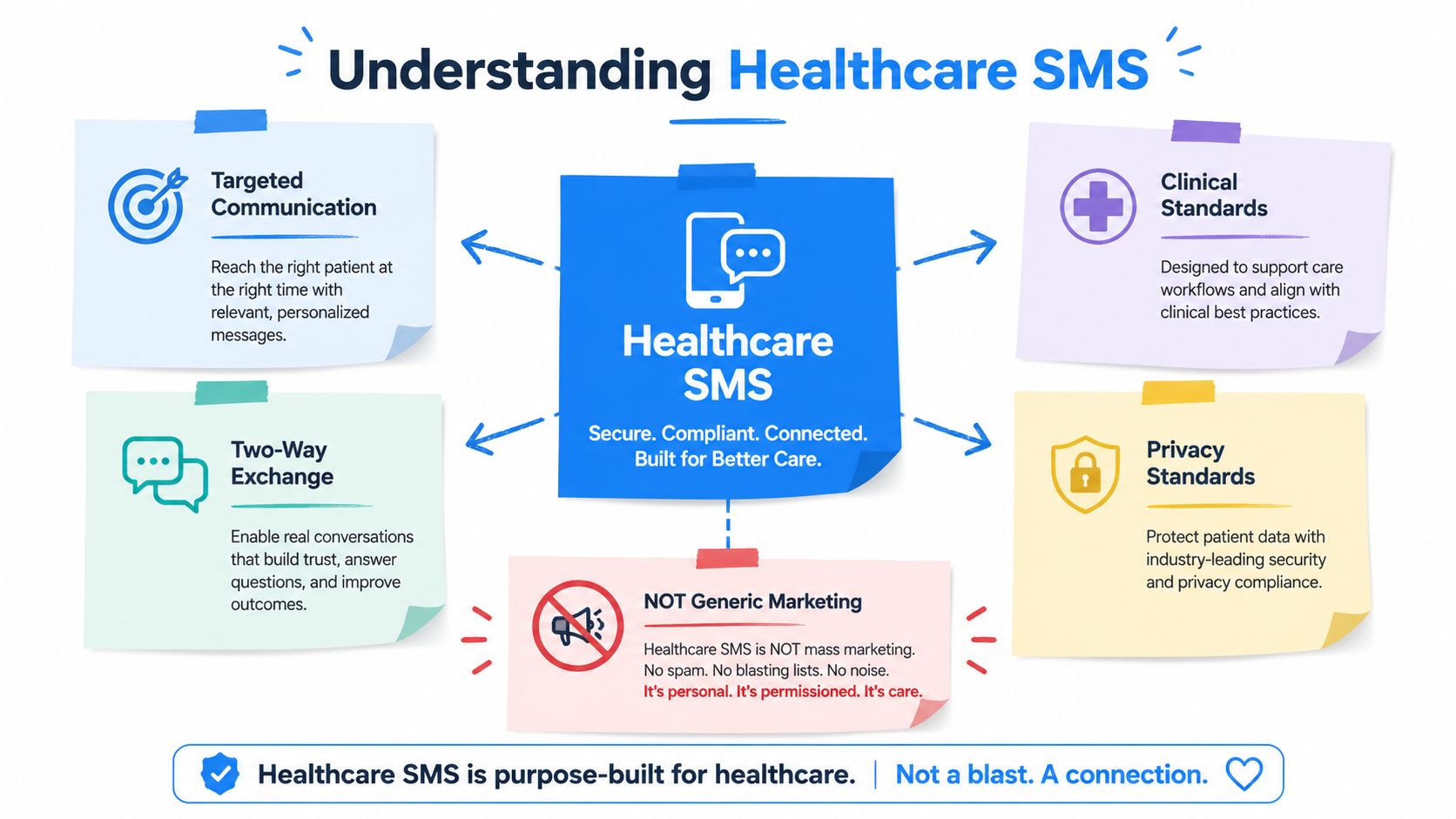
Think of healthcare texting like a digital sticky note. It can carry one clear reminder, one callback number, or one next step. The note is useful because it's short. It's risky if it gets overloaded with private details that don't belong in a standard text.
What makes it different from generic texting
Healthcare SMS is not a bulk blast with no context. It's a targeted exchange that supports scheduling, care coordination, or follow-up while staying within clinical and privacy rules. In practice, that means the message should help the patient do something, confirm something, or move to a more secure channel when details are sensitive.
That's also why SMS works best as part of a system, not as a standalone habit. A text can remind someone about an appointment, but it can also route them to a portal, a secure inbox, or a live staff member when the next step needs more detail. The strongest patient-preference signal in 2026 points in the same direction, with 93% of patients opting in to receive texts from providers and 97% saying they want appointment reminders by text (2026 healthcare communication survey).
Practical rule: if a text would be awkward to leave on an answering machine, it's probably too detailed for standard SMS.
Where behavior design comes in
A lot of teams ask whether SMS should be one-way or two-way. The better question is which patient behavior you want to trigger. A one-way reminder is fine for a simple visit confirmation. A two-way message is better when you need a reply, such as confirming transportation, rescheduling, or answering a narrow operational question.
That's where tools like automating business texts become relevant, because automation only works well when the message design matches the patient action you want. If the message is vague, the reply is vague too. If it's specific, brief, and easy to answer, the workflow gets cleaner.
Benefits and Risks of Healthcare SMS
A clinic can send a reminder, but a primary concern is whether the patient knows what to do next. Healthcare SMS works well because it turns intent into a small, clear action. A text arrives where people already look during the day, so the next step is easier to notice than a voicemail or a portal alert.
What the evidence says about attendance
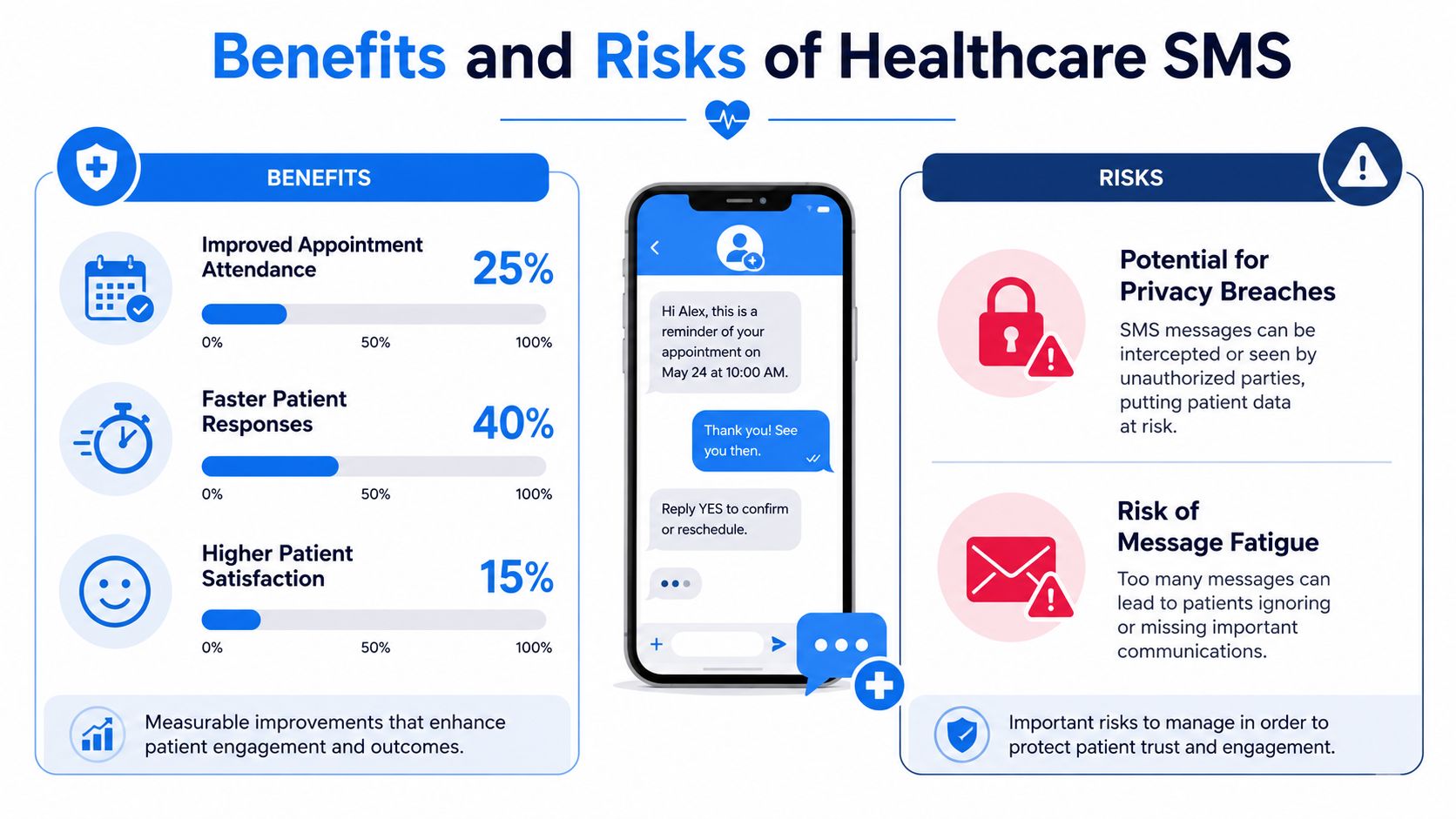
The strongest benefit shows up in appointment attendance. A Cochrane review found that attendance rose with SMS reminders, and text reminders performed similarly to phone-call reminders. That matters because clinics are usually not trying to persuade patients with a long explanation, they are trying to get a simple yes, no, or reschedule response.
A short reminder works like a signpost at the right turn. It does not replace every other channel, and it does not need to. It helps most when the message is tied to one decision point, sent at the right time, and written so the patient can understand it at a glance.
Where the risks show up
The risk side starts with privacy. Standard SMS is not end-to-end encrypted, so if staff include diagnosis names, treatment details, or extra identifiers, they can expose information the patient did not need in a text. Safer programs keep messages to minimum-necessary operational details, pair them with a signed BAA, document patient consent, and maintain audit logs, as described in HIPAA-compliant texting guidance and HIPAA-oriented guidance.
Consent is part of the behavior design, not just the compliance file. If a patient never clearly agreed to receive texts, or if the opt-out path is hard to use, the program creates friction instead of trust. The same is true when message templates are too broad, because a vague text invites unnecessary detail while a narrow one keeps staff focused on the action the patient needs to take.
Message fatigue is the other risk. If patients receive too many reminders, or reminders that do not help them act, they start treating every text like background noise. A healthcare SMS program works better when it feels like a useful nudge service, with message frequency and wording matched to the task, rather than a stream of generic alerts.
Legal and Compliance Requirements
The compliance question is simpler when you break it into parts. First, classify the message. Then collect consent. Then send only what belongs in a text. That sequence keeps the program from drifting into risky territory.
Start with message classification and consent
Every campaign and template should be sorted by purpose. Under HIPAA, that usually means treatment, healthcare operations, or marketing. Under TCPA, it means determining whether the text is informational or telemarketing. The safest way to get started is a standalone opt-in that names the practice, the message types, and the frequency, so patients know exactly what they're agreeing to.
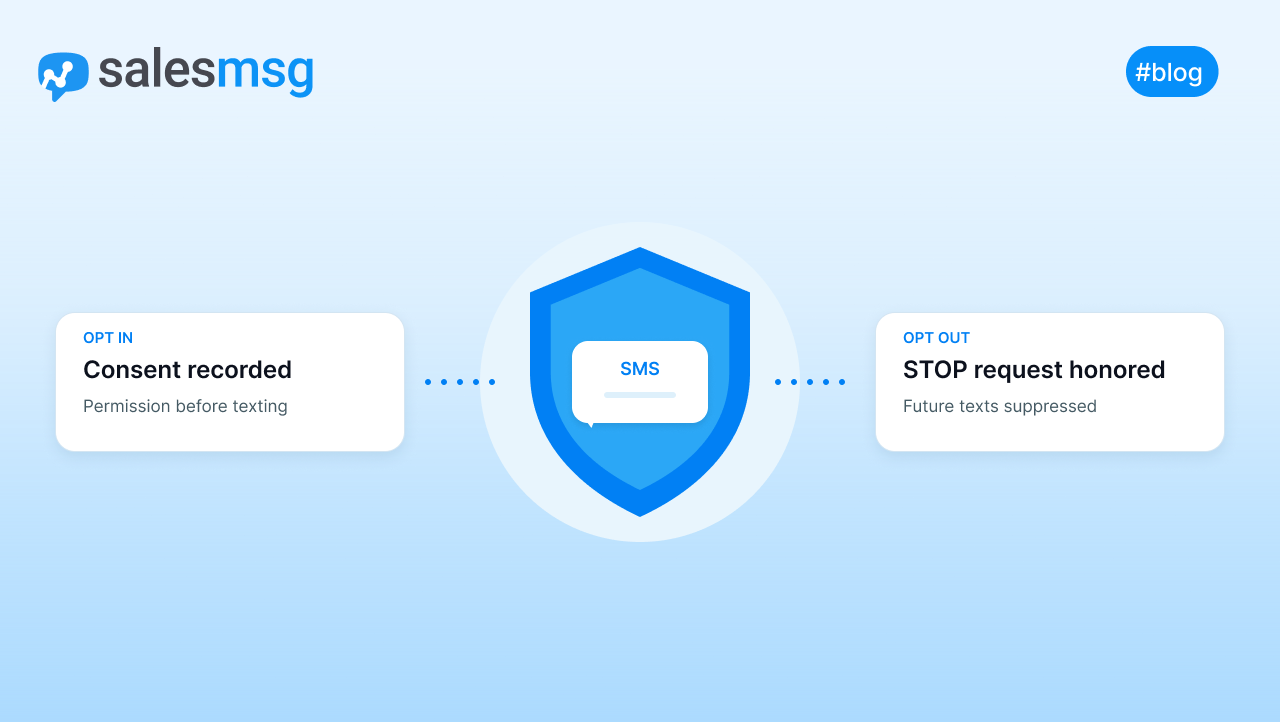
Consent handling matters just as much after enrollment. Opt-out requests like STOP and alternative phrases should be honored across channels within 10 business days, and consent records should be written, time-stamped, and retained for at least four years (compliance workflow guidance). If your staff can't find the record, you don't really have the record.
Keep the message body narrow
For unencrypted texting, the cleanest rule is to keep the body to minimum necessary operational details. That usually means appointment date, time, maybe location, and a callback number. If the message needs clinical detail, it belongs in a secure portal or another protected workflow.
When texting unencrypted health information, HIPAA requires the provider to inform the patient of the encryption risk, obtain authorization that the patient is willing to accept that risk, and document consent (compliant texting guidance). That three-part mechanic is more useful than a vague “be secure” warning because it tells your team exactly what has to happen.
Compliance shortcut: if the text can be trimmed without hurting the patient's next action, trim it.
A platform choice still matters, and if you're comparing setup models, a guide on HIPAA compliant texting can help teams think through the workflow controls they need before launch.

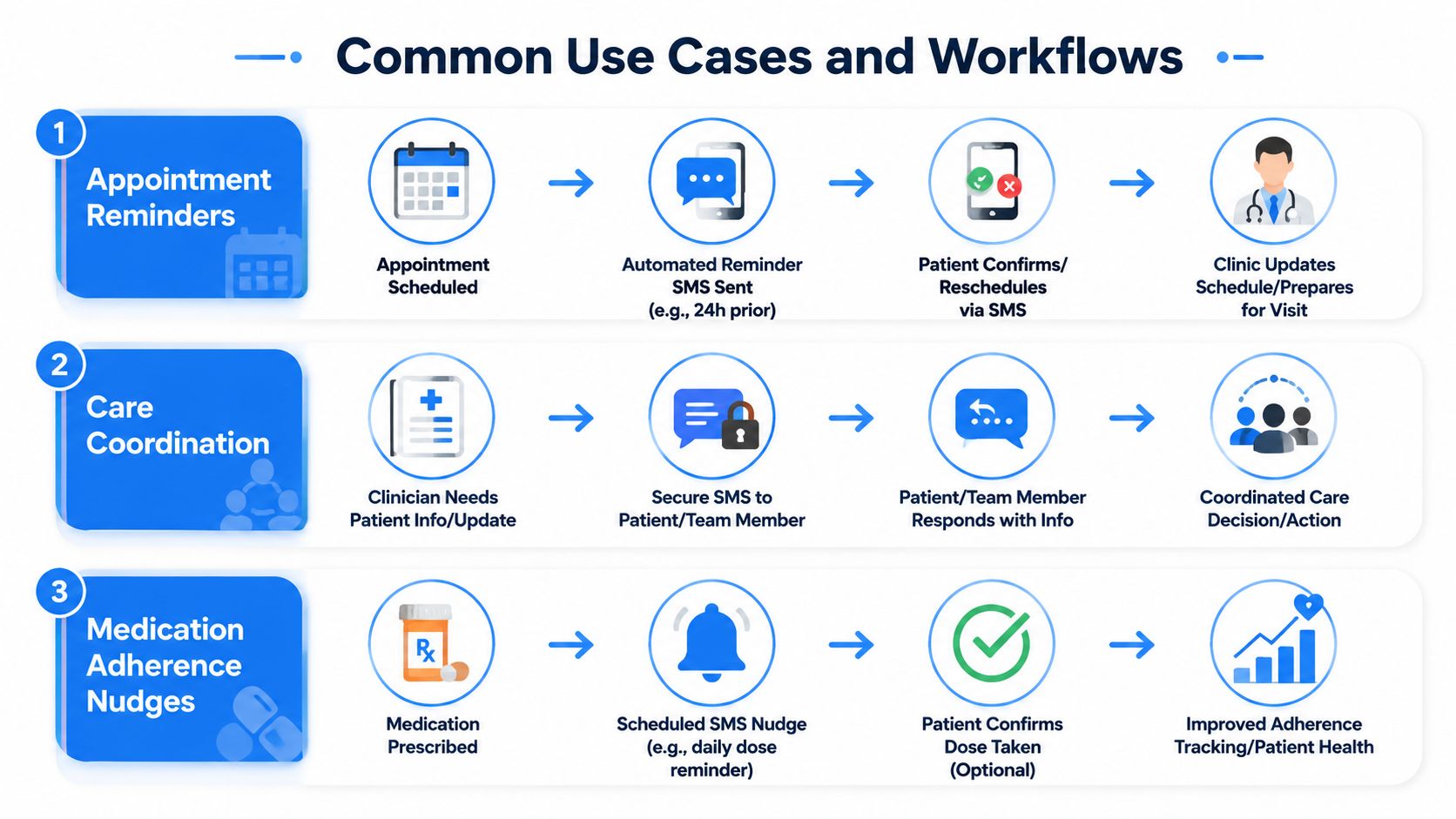
Common Use Cases and Workflows
Healthcare SMS gets more useful when you stop thinking about “sending a text” and start thinking about a workflow. The best programs connect a trigger, a message template, and a follow-up action. That structure reduces manual work and keeps replies from getting lost.
Appointment reminders that actually move the schedule
The simplest workflow starts when an appointment is scheduled in the EHR or practice system. The reminder text goes out at the right time, often with just enough detail for the patient to confirm or reschedule. If the patient replies, the front desk updates the schedule and the slot gets reused sooner.
That same pattern is where a resource like creating a text message appointment reminder can be useful, because reminder quality depends on the wording, timing, and reply handling, not just on the fact that a message was sent.
Care coordination and narrow updates
Care coordination messages work best when the ask is specific. A nurse may need a patient to confirm a medication change, or a care team member may need a quick status update before a follow-up call. In those cases, text is a bridge, not the finish line.
The earlier message design point matters here. A long message creates confusion. A narrow message gets a narrow answer. That makes triage easier for staff and less stressful for the patient.
Medication adherence and other operational nudges
Texting is also used for medication adherence, chronic disease management, behavioral health check-ins, and lab or imaging result notifications (multichannel healthcare SMS use cases). Those uses all share the same logic. They push a patient toward one small action at a time.
- Appointment reminders: Send the reminder, capture the reply, and route confirmations or reschedules into the scheduling workflow.
- Care coordination: Ask one clear question, then hand the response to the right team member.
- Medication nudges: Keep the note brief, then link to a secure channel if the patient needs more detail.
Implementation Checklist for Healthcare SMS
A good launch starts with governance, not templates. If the policy is shaky, the messaging will be shaky too. The checklist below keeps the launch practical and keeps the risk visible.
- Secure patient opt-in first: Capture consent before the first text goes out. Keep the language plain, name the practice, and spell out the kinds of texts patients will receive.
- Inventory every template: Sort each message as treatment, operations, or marketing. That classification tells your team which approval path and safeguards apply.
- Map the workflow to a real owner: Decide who sends, who reviews replies, and who handles escalations. If nobody owns the thread, replies will stall.
- Integrate with the EHR or CRM: Connect the texting workflow to the record system so scheduling, reminders, and reply handling don't live in separate silos.
- Provision the right numbers and registration path: Confirm your messaging setup supports healthcare use cases and the registration requirements tied to your texting volume and routing model.
- Set role-based access controls: Only staff who need the data should see the inbox. That cuts down on accidental disclosure.
- Log every action: Track who sent the text, when it went out, and how the patient replied. Auditability matters as much as delivery.
- Build opt-out handling into every send: STOP requests should be processed quickly and consistently across channels.
- Keep a secure fallback ready: If a message needs clinical detail, route the patient to a portal or another protected channel instead of putting the detail in SMS.
- Review consent records regularly: Make sure the documentation is time-stamped, easy to retrieve, and still aligned with current workflows.
If you want one platform example to examine during vendor review, Salesmsg includes two-way texting, workflow logging, and HIPAA-oriented controls in a CRM-friendly setup. That doesn't replace your policy work, but it gives operations teams a concrete reference point for how a texting stack can sit inside a broader system.
Evaluating Performance and Choosing a Vendor
Performance is easy to measure if you pick the right signals. Start with whether the message arrived, then whether the patient replied, then whether the patient did the thing you wanted, like confirming, rescheduling, or showing up. That sequence is more useful than vanity metrics because it connects the text to the workflow outcome.
What to measure
The most important KPI is still the one tied to operations. If reminder texts are going out but no-shows aren't falling, the issue may be timing, wording, or reply handling. If replies are coming in but the front desk isn't acting on them fast enough, the bottleneck is internal, not technical.
Message design is a big part of that. Research on SMS interventions has found stronger effects when campaigns are personalized, bidirectional, and sent less than daily (systematic review). That doesn't mean every clinic needs a chatty program. It means the strongest programs are usually the ones that feel specific and respectful, not generic and repetitive.
How to compare vendors
A healthcare SMS vendor should make compliance easier, not harder. Look for HIPAA support, access controls, logging, and a clear consent workflow. Then compare the operational pieces, like EHR or CRM integration, message templates, segmentation, and how replies are routed to staff.
A simple side-by-side test helps:
- Compliance fit: Does the platform support your consent, logging, and access control requirements?
- Workflow fit: Can it trigger from patient events, not just manual sends?
- Message design fit: Can you personalize and bidirectionally route replies without creating inbox chaos?
- Operations fit: Can the front desk or care team see what they need without seeing too much?
The best choice is the one that matches how your clinic already works, or how you want it to work after launch. If your team values a shared inbox, CRM logging, and automated follow-up, choose a system that treats messaging as a workflow layer, not a standalone blast tool.
Conclusion and Next Steps
Healthcare SMS works because it solves two problems at once. It helps patients act on reminders, and it helps clinics reduce manual follow-up. The strongest programs keep the message short, the workflow clear, and the privacy guardrails tight.
The next move is practical. Audit your current reminders, choose one high-value use case, and assign ownership across scheduling, compliance, and IT. Then test one message pattern, review the replies, and tighten the template before expanding. If you can make the first workflow clean, the rest gets much easier.